

THE TAKEAWAYS
What to take away
- Separate access termination, eligibility, deletion requests and verified completion
- Do not assume identical R2 and S3 timing or historical-version semantics
- Include derivatives and recovery in inventories and verification procedures
EDITORIAL PRACTICE
Ending access and deleting data are separate decisions
When an AI workflow ends, do you assume that disabling an account also deletes its data? Interface access, shared links, queued jobs, source files, extracted text, search data, logs and backups are separate management targets. Changing one does not establish that every other target reached the same state.
Conversely, setting a retention deadline does not mean everyone may keep using the data until that date. Access may end when an engagement or assignment ends, while authorized information remains managed for a defined purpose until deletion conditions are met. This article does not determine legal retention periods. It explains how to translate those decisions into technical operations.
Cloudflare R2 and Amazon S3 provide object lifecycle features, but eligibility conditions, completion timing and version handling differ by service and configuration. Saving a lifecycle configuration is separate from confirming that access has ended and all related data has been removed. Design observable states for those distinct events. [1][2][3]
We use a fictional AI document-processing service to separate access termination, retention policy, deletion execution, verification and handover. Periods such as thirty days are illustrative assumptions, not statutory deadlines or a company’s contractual terms. Responsible business, contractual and specialist owners decide what to retain and for how long; the development team implements those conditions.
Delegating offboarding requires an agreed inventory, rationale, owner and verification method, rather than asking the product owner to find and delete storage after each engagement. Neither retaining more nor deleting sooner is universally correct. The operational deliverable should follow the agreed policy, expose exceptions and explain what was actually established.
EDITORIAL PRACTICE
Inventory derivatives and copies, not only source files
An AI workflow may create several artifacts from one upload: an original image or document, extracted text, chunks, search indexes, generated results and user-facing outputs. Establish what your own architecture actually produces. Do not assume all AI services create the same artifacts; map your implementation’s data flow.
For each artifact, record its storage location, identification method, relationship to its source, consuming processes and responsible owner. Without traceability, deleting the original can leave indexes or outputs behind. Name-only matching can also delete an unrelated engagement. Identification needs more than similar filenames.
Separate information visible in business interfaces from operational and recovery data. Logs, error attachments, backups and exports may not appear in ordinary screens. Inventory confirmed locations and label unexplored locations as unverified. An unverified target must not be included in a confirmed deletion count.
If information was sent to an external processor, separately review that service’s contract, documentation and management capabilities. This article sets no universal AI-provider retention period. Distinguish your control from actions or answers required from another party, and record requesting, acceptance and completion as separate events.
Do not copy the source content into the inventory itself unnecessarily. Prefer identification, location, policy and results, minimizing new confidential or personal data. Identifiers and hashes can remain meaningful when linked to other information, so do not automatically call them anonymous; define appropriate access.
EDITORIAL PRACTICE
A retention policy needs a trigger and purpose, not just days
“Keep for thirty days” does not specify when the clock starts. Upload, processing completion, engagement termination and last use produce different deadlines. Include the artifact category, purpose, trigger, calculation method and exception decision maker so implementation does not fill gaps by guesswork.
For a fictional policy, let engagement termination be day zero and retention continue until day thirty. If a source was created on day minus twenty, a creation-plus-thirty-days rule instead expires on day ten. The clocks differ by twenty days. This arithmetic is not a recommended service setting; it illustrates why business and technical triggers must align.
Specify how time, dates and time zones affect the boundary. Decide which regional day applies and how a request arriving exactly at the deadline is handled. Translate the policy into the selected service’s conditions while retaining the original rationale. Configuration alone may not explain why a deadline was chosen.
Derivatives do not necessarily share the original file’s deadline. Temporary analysis and a delivered output may have different purposes or contractual treatment. The article does not choose which should remain longer. Apply authorized conditions per category rather than silently assuming everything either disappears with the source or remains indefinitely.
Record the scope and date of policy changes. Applying a change only to future artifacts differs from applying it to existing data. Read the affected inventory and current deadlines before changing configuration, and resolve exceptions first. Shortening a period can immediately make older data eligible for deletion.
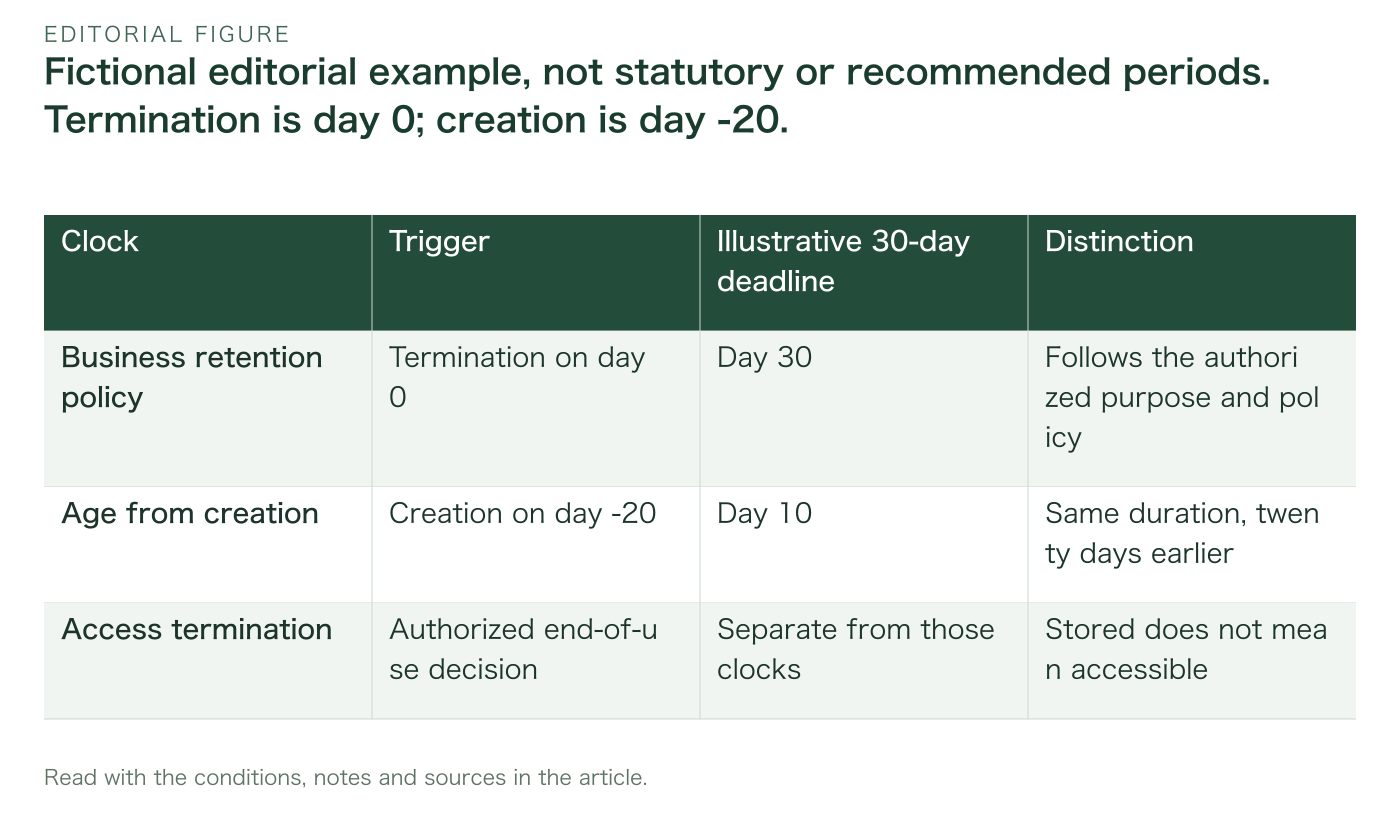
Read the table as text
| Clock | Trigger | Illustrative 30-day deadline | Distinction |
|---|---|---|---|
| Business retention policy | Termination on day 0 | Day 30 | Follows the authorized purpose and policy |
| Age from creation | Creation on day -20 | Day 10 | Same duration, twenty days earlier |
| Access termination | Authorized end-of-use decision | Separate from those clocks | Stored does not mean accessible |
EDITORIAL PRACTICE
Verify access termination separately from storage
Review actual access paths: interface login, APIs, shared links, scheduled processing, administrators and integrations. A disabled account label does not prove that issued credentials or alternate routes are unusable. Define revocation and verification for the authentication and delivery mechanisms actually deployed.
AWS IAM’s role-session revocation documentation distinguishes permission control over issued temporary credentials from the ability to assume a role later. It is not a procedure for every application token, but it illustrates why admission permissions and issued sessions need separate consideration. [4]
The documented procedure can affect multiple users of a role. Do not accidentally stop a shared production role while intending to offboard one person. Authorized operators should use approved procedures with a confirmed scope, rather than treating this general article as an instruction to change production. [4]
Define whether suspension prevents reading, new processing requests and writes. Check for differences such as a blocked interface with a still-usable API. Data may remain managed for an authorized purpose while a former user cannot access it. Represent those as distinct states in interfaces and operational records.
Use an unprivileged test identity and safe checks appropriate to the authorized scope to establish denial on important routes. Do not switch a real customer’s permissions without authorization. Avoid assuming instantaneous propagation everywhere: record the chosen service’s behavior and the results actually observed.
EDITORIAL PRACTICE
R2 expiration and deletion completion are not the same instant
Cloudflare’s R2 documentation says objects are typically removed within twenty-four hours of the x-amz-expiration value. That is not a guarantee of physical deletion exactly at expiration. If usage must stop at a deadline, separately design application and delivery authorization instead of relying only on lifecycle completion. [1]
The documentation also describes delayed application of changed lifecycle configurations to existing objects, potentially taking longer depending on their number. A saved configuration or one immediately observed header does not prove every existing object has adopted the new rule. Link the rule, target scope and readback evidence, tracking targets not yet reflected. [1]
R2 describes a default lifecycle rule expiring multipart uploads seven days after initiation. This does not mean every completed file is deleted after seven days. Distinguish incomplete uploads from ordinary objects and confirm what the chosen implementation creates and cleans up. [1]
When grouping lifecycle targets by a prefix or other supported scope, check that storage classification matches retention policy. Similar engagement names or data with different deadlines should not silently share a rule. Before copying a configuration example, inspect its actual targets and consider the effects of classification changes or moves.
An application might distinguish before-deadline, access-disabled, eligible-for-deletion, pending, verified-deleted and exception states. These are editorial operational labels, not R2’s standard state names. Do not count eligibility as completion. Recording what was checked supports accurate explanations to users and owners.
EDITORIAL PRACTICE
In S3, examine current and noncurrent versions separately
Amazon S3 documents asynchronous removal after queuing expiration for a nonversioned bucket. In a versioning-enabled bucket, expiration may add a delete marker and make the previous current version noncurrent. An ordinary retrieval no longer showing the object is not equivalent to permanently removing every version. [3]
Deleting noncurrent versions involves separate configuration such as NoncurrentVersionExpiration. Review retained generations, elapsed days and the actual bucket state instead of assuming a current-version rule removes all history. API compatibility between R2 and S3 does not establish identical retention and deletion semantics. [3]
S3 lifecycle rules also apply to existing objects. Shortening expiration while intending to affect new data alone can immediately queue older objects. Before applying changes, inspect scope, creation times and version state, and separate still-needed data and exceptions. [2]
For general-purpose buckets, AWS explains that a bucket-policy denial does not itself prevent lifecycle deletion or transition. Do not treat denying access as preserving data. Access suspension and suspension of deletion are not automatically one operation; use the selected service’s supported preservation features and authorized process where needed. [2]
The documentation also identifies conditions involving Object Lock and replication status. This article does not decide whether those features or particular retention periods are required. Operationally, distinguish such exceptions from ordinary delay or success, retaining the rationale, verification owner and authority to release an exception. [3]
EDITORIAL PRACTICE
Prevent pre-suspension jobs from recreating deleted data
An asynchronous job accepted before suspension may execute later. A running task might save extracted text or search data after its source has been removed, reintroducing artifacts into an apparently closed engagement. Inventory both existing deletion targets and processes that can still create data.
Our design example checks an engagement or user’s permitted processing state at admission and again before saving results. An admission-only check misses policy changes during a long task. Choose checkpoints for the actual architecture; do not assume a cloud service understands and enforces your business status automatically.
Record the decision time, target and policy version, or equivalent information that later processing can consult. These are custom design fields, not standard cloud attributes. Recovery and retry paths must observe the same boundary instead of resuming from an obsolete authorization state.
Distinguish unknown outcomes from unexecuted work. Copying originals or assigning new identifiers merely to retry can create artifacts outside the deletion inventory. Include retry authorization, generated-artifact traceability and reconciliation with cancellation or deletion targets in the operating process.
Some authorized tasks may remain necessary after suspension, such as an agreed export or preservation step. Separate these from ordinary reactivation, with explicit purpose, scope, owner and deadline. Avoid an unlimited convenience exception that silently restores general processing.
Reactivation should not silently revive old jobs or retention policies. Reusing identifiers can mix pre-suspension work and pending deletion with new use. Confirm the reopened scope, applicable policy version and basis for reusing historical data, distinguishing new admission from rerunning old work. Never promise that deleted information is inherently recoverable. A replacement operator also needs previous exceptions and unresolved issues.
EDITORIAL PRACTICE
Extend deletion coverage to derivatives, logs and recovery
After the source disappears, check actual locations for extracted text, indexes, generated outputs, previews and deliverables. Link those targets to the original and track completion, uncertainty and exceptions per location. Do not assume one operation removes everything.
Logs and diagnostic attachments may sit outside ordinary deletion paths. First consider avoiding source-content logging, then define the purpose and retention of necessary diagnostics. A deletion audit must not recreate the content being deleted in a new log. Aim for enough evidence to explain the outcome without needless content retention.
For backups, identify their data snapshot and the restoration behavior. A production-deleted target should not silently become available after recovery. Responsible owners decide retention and exceptions; technical operators verify how suspension and deletion state will be reapplied after restoration. Deleting backups indiscriminately is not the proposed solution.
Clarify what can be inspected or controlled in external systems and copies downloaded by users. Confirmation in your bucket does not establish deletion of every outside copy. Record required requests, targets, responses and remaining uncertainty separately so completion has an explicit scope.
For a VERSAROC consultation, describe missing source-to-derivative links, unknown storage locations or undefined restoration handling. Define development and operations across inventory, state management, processing boundaries and verification reports. The system should implement authorized policy rather than automatically determine legal duties or individual contracts.
EDITORIAL PRACTICE
Keep request, acceptance and completion evidence separate
A deletion request being accepted is separate from completion at each destination. Returning a request number as “done” obscures asynchronous or unverified work. Align user-facing and operational states so both show what is complete and what remains unconfirmed.
Choose verification for the storage model: object inventory, versions, derivative mappings, denied access and pending work may all be relevant. A missing URL describes that route, not necessarily every version or recovery copy. Do not declare completion beyond the scope checked.
Separate candidate, requested, verified, exception and unverified counts. If ten fictional targets exist and eight are confirmed, the remaining two must not be folded into success. This is an illustrative accounting example, not a service failure rate. Identify what needs checking next and who owns it.
Decide what evidence operations and review actually require, such as target identity, policy version, timestamps, result and exception reason. Do not retain deleted document content as the proof. The evidence itself also needs access controls and retention rather than an automatic indefinite exemption.
When rechecking changes the outcome, record which targets were revisited and when, rather than simply overwriting the old result. A deadline arriving, service processing progressing and an exception being released are different causes. Preserve enough context for a replacement operator to choose the next check.
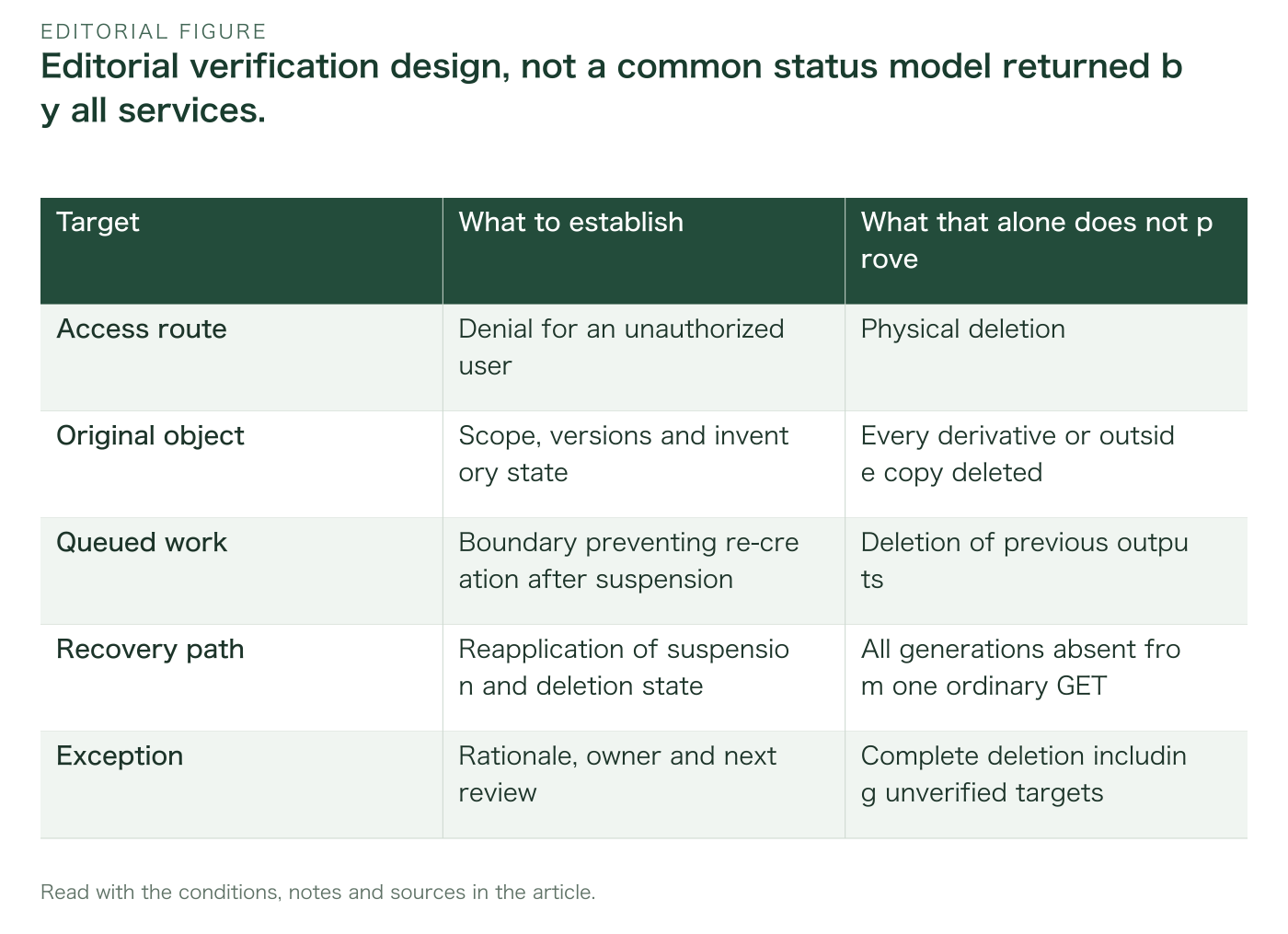
Read the table as text
| Target | What to establish | What that alone does not prove |
|---|---|---|
| Access route | Denial for an unauthorized user | Physical deletion |
| Original object | Scope, versions and inventory state | Every derivative or outside copy deleted |
| Queued work | Boundary preventing re-creation after suspension | Deletion of previous outputs |
| Recovery path | Reapplication of suspension and deletion state | All generations absent from one ordinary GET |
| Exception | Rationale, owner and next review | Complete deletion including unverified targets |
EDITORIAL PRACTICE
Manage exceptions with a reason and an authorized release owner
An unresolved target needs more than a generic failure label. Distinguish approved preservation, external-response waiting, replication checks and unidentified targets. Appropriate owners must determine legal or contractual requirements; operators should not use the article’s illustrative periods as those decisions.
Give each exception a scope, rationale, decision maker, next review and release conditions. Avoid both hiding exceptions within completion and retaining data indefinitely without reason. Define whom to contact at review time so an engagement’s end or an operator’s departure does not leave the case unmanaged.
Configuration can also create exceptions. Broad lifecycle rules applied before existing data is classified may include still-needed targets. Inspect scope read-only first and consider checking behavior against a small isolated set. Do not compensate for inadequate review by assuming deletion can simply be reversed later.
For irreversible deletion, define who confirms targets and rationale and where execution is authorized. This need not require manual review of every object by the product owner, but automation must remain within agreed permissions and scope. Include recovery limitations in the policy that can be explained to users.
Numerous exceptions may indicate an inventory or policy problem rather than isolated deletion failures. Missing source mappings, unknown locations and unwritten arrangements may need attention before more automation. Check whether decision-making information is missing before adding another feature.
EDITORIAL PRACTICE
Hand over verification procedures with the configuration
Hand over artifact categories, policy triggers, access routes, derivative inventory, exceptions and verification methods, not just retention days and bucket names. A new operator should understand why the scope and deadline exist. Settings alone can lose the connection to business purpose and contracts.
Acceptance checks should include suspension during active work, pending processing after eligibility, noncurrent versions and external-response waiting, not only normal completion. Use fictional data and isolated environments where appropriate to demonstrate that suspension, eligibility, confirmation and exceptions remain distinct.
Assign responsibility for reviewing primary documentation and updating procedures when cloud capabilities change. Do not apply previously read billing or deletion behavior from a different service: R2 and S3 are not interchangeable in every respect. Retain before-and-after readbacks and dates of the supporting documentation.
Operational reporting should expose overdue verification and ownerless exceptions, not merely total processing counts. This lets the product owner focus on decisions instead of searching storage repeatedly. Retain necessary decisions while delegating investigation, execution preparation, checking and record updates as a continuing scope.
Through OPERUN’s contact route, describe difficulties with storage inventory, offboarding access, derivative tracking, verification reports or handover. A VERSAROC technical consultation can connect business policy to implementation and delegated operation. Legal retention periods and individual contractual judgments remain with the responsible owners and specialists.
EDITORIAL PRACTICE
Replace “it should be deleted” with an observable offboarding process
Treat loss of access, authorized retention, deletion eligibility and verified deletion as distinct outcomes. Covering derivatives, queued work, logs and recovery alongside originals makes it easier to explain what was operated and what was actually established.
Start by requesting the data flow, retention policy, access routes, offboarding tasks and completion checks. Improve identification and classification before automating deletion of an unclear target set. Separate policy decision makers from the team implementing and operating those decisions, and expose exception decision points.
Do not call a deadline or accepted request completion. Record the verification method, scope and remaining uncertainty. Avoid hiding retained data inside success or assuming everything remains without evidence. Choose the next check from observed facts.
The relevant primary references were read on November 7, 2026: Cloudflare R2 Object lifecycles, Amazon S3 lifecycle and expiration, and AWS IAM role-session revocation. Typical processing times are not absolute guarantees, and service differences are retained. The classifications, state names and fictional time periods are editorial proposals.
WITH OPERUN.
Delegate everyday AI management.
If people repeatedly supplement retention and deletion instructions manually, consider a traceable agreement and verification system rather than adding more ad hoc decisions. Clarify what stops when, what is deleted under which conditions and what evidence closes the task. Delegate development and operation against that policy so the workflow remains explainable after it ends.
Discuss your product and AI workPrimary sources
Sources checked on 7 November 2026. The workflows and checklists are editorial proposals.
- [1]
- [2]
- [3]
- [4]
Share this insight