

THE TAKEAWAYS
What to take away
- Separate the API response, local application, committed round and downstream business completion; identify the scope represented by a success timestamp.
- Keep the GitHub, Graph and Calendar continuation contracts distinct, and distinguish an in-progress position from the checkpoint for the next round.
- Treat deletion, incomplete retrieval, permission changes and late results from older runs as distinct acceptance cases using fictional responses.
- Retain official-specification evidence separately from tests of the implemented integration, and withhold unverified state from AI workflows.
EDITORIAL PRACTICE
The synchronization scope and what completion means
An integration screen built by an overseas development team shows a green “Synchronization successful” message. Yet the business report produced by AI includes only some of the projects. Consider a hypothetical project list spread across several pages: the system updated its success timestamp as soon as it fetched the first page. Receiving an HTTP response, saving items, completing a round over the defined scope, and finishing the business report each require their own confirmation.
A small test dataset can make missing pagination hard to detect. Nor does one successful initial run establish what happens when an item is updated later, deleted during processing, or affected by a change in synchronization permissions. At acceptance, you need to know more than whether data appeared: what was in scope, how much was applied, and what remains incomplete. With those boundaries recorded, operations staff can make decisions from evidence rather than the color of a status indicator.
This article covers synchronization that periodically reads external data and passes it to business processes or AI. Its main subject is neither acknowledging webhooks nor the procedure for rerunning a failed business operation. Instead, it makes the required deliverables concrete around the end of enumeration, the position used to resume an interrupted run, deletions, and the commitment of incremental changes. Begin by connecting the chosen API's official specification to the consistency conditions your business needs, rather than imposing one universal resume method on every API.
“All projects” is not enough to define a synchronization scope. Record the service, organization or account, collection, API version, selected fields, filters, and access permissions. Also agree whether “all” means everything visible to one staff member or everything across the organization. This avoids implying that items hidden by permissions were retrieved. When the scope changes, explicitly check whether the previous incremental checkpoint may still be used.
One proposed ledger design links the connection identifier and the version of the query conditions to the committed synchronization checkpoint. The purpose is to avoid reusing a position obtained for a different customer or filter. You do not need to paste the token itself or credentials into human-readable design documents and reports. Keep a safe way to establish which settings produced it, and handle its raw value only in the execution environment that needs it. Avoid relying on developers to hand over copied strings manually.
A change to the query conditions deserves more attention than a minor screen change. If you narrow the date range or add fields to import, decide how existing local data relates to the new result. If the change requires fetching the data again, also design what will be shown as unverified in the meantime. Avoid a system in which every change to an operator's search conditions silently changes the meaning of past commit records. Retain the reason for the change and the checks that must follow.
EDITORIAL PRACTICE
API-specific pagination and the end of a round
GitHub's official REST API documentation explains that, when results are paginated, URLs in the Link header can be used to fetch additional pages. Check the chosen endpoint to establish whether increasing a page number is supported and which link identifies the next page. This is not a header specification shared by every API. The starting point is to avoid deciding that the entire scope has been fetched merely because one response contained only a small number of items.
Ask the development team to document where it obtains the continuation position, what it carries into the next request, and what establishes the end of the results. It is also important not to assume that increasing the maximum item count will make everything fit into one request. Item limits and return order differ between APIs, and changing conditions can change the meaning of the result. If the actual specification is unclear, make checking that endpoint's contract a distinct task before writing generic pagination code.
If the design follows a continuation URL returned in a response, include the handling of that URL in the contract. Check the allowed destinations and how requests are constructed so credentials are not sent to a different destination. Distinguish this from an implementation that parses a token and rewrites it into a convenient number without support from the provider. Establish both safe destination checks and rules against inventing new pagination semantics, and decide how to keep raw continuation positions out of routine logs.
Microsoft Graph's delta query documentation says to continue retrieving results while a nextLink is present, even if the result is empty, until a deltaLink is returned. The deltaLink indicates that no more data about the current state remains to be returned in that session, and is used to check for subsequent changes. This distinction does not apply uniformly to empty arrays from other APIs. Under this Graph contract, at least, “the data is empty, so stop” is not a sufficient implementation.
Define acceptance as a combination of reaching the officially specified end and completing the required local application of the data, rather than as a response item count. Even if the end has been received, local synchronization is incomplete if saving that page failed. Conversely, saving one page does not establish that no next page exists. Define when the success timestamp on the screen is updated by examining both retrieval and storage.
Attach a scope and a criterion to any “complete” status. Finishing one round does not guarantee that changes occurring after that point have also been fetched. Separate the record that “the previous round was committed for this connection and these conditions” from the policy used to judge freshness. If an AI report needs current information, connect the committed synchronization point to the scope used to generate the report. Do not treat data as current merely because the synchronization job started recently.
EDITORIAL PRACTICE
Applied data and the committed checkpoint
The editorial proposal is to manage an in-progress resume position separately from the committed checkpoint for a completed round. For example, suppose a hypothetical three-page list stops immediately after the second response is received. If the system has already advanced the saved position solely on receipt of that response, it may skip items that have not yet been imported. Design the system so it can explain how far the page contents, local application, and position for proceeding to the next page have been committed together.
Where the storage arrangement allows a single commit, consider committing page application and the position update together. If they span separate services and cannot be committed as one operation, record states such as fetched, being applied, and applied, and design the point from which to restart. This is not a promise that a particular database feature makes the entire process execute exactly once. Use tests that interrupt processing to check that unapplied pages are not skipped and that reapplying the same page is handled.
Do not lose the previous committed checkpoint while the next round is still running. If the in-progress position becomes corrupted or unusable, it matters where rechecking can begin. However, do not assume that an old position remains valid forever. Retained state should include the scope, a state version, and whether it is in progress or committed. The distinction prevents a partially imported current round from being displayed, after recovery from an error, as though every change since the previous round has been applied.
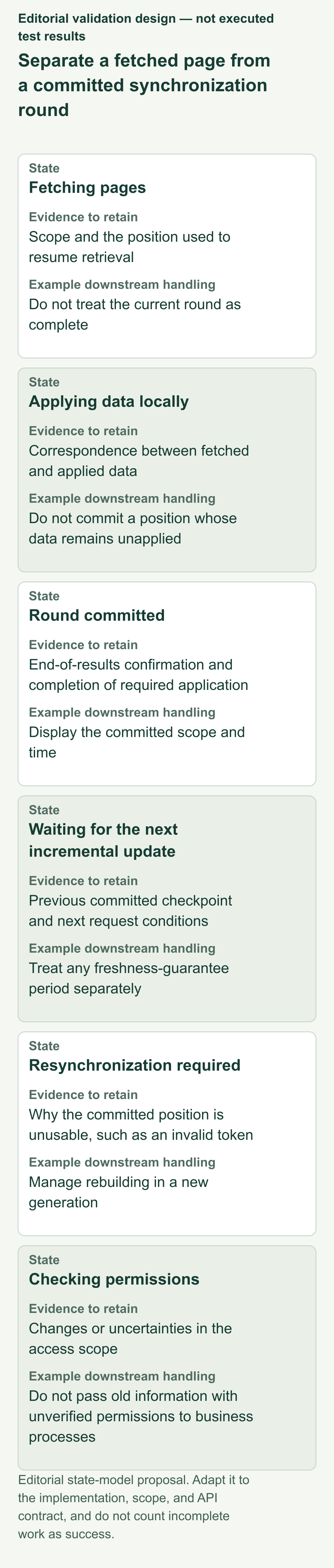
| State | Evidence to retain | Example downstream handling |
|---|---|---|
| Fetching pages | Scope and the position used to resume retrieval | Do not treat the current round as complete |
| Applying data locally | Correspondence between fetched and applied data | Do not commit a position whose data remains unapplied |
| Round committed | End-of-results confirmation and completion of required application | Display the committed scope and time |
| Waiting for the next incremental update | Previous committed checkpoint and next request conditions | Treat any freshness-guarantee period separately |
| Resynchronization required | Why the committed position is unusable, such as an invalid token | Manage rebuilding in a new generation |
| Checking permissions | Changes or uncertainties in the access scope | Do not pass old information with unverified permissions to business processes |
EDITORIAL PRACTICE
Tokens for the next page and the next synchronization
In Google Calendar's official synchronization guide, nextSyncToken, used for the next synchronization, appears only on the last page when results are paginated. If a pageToken is returned during incremental retrieval, the guide describes following later pages with the same syncToken and query conditions. Keep these two roles separate rather than overwriting a single field called “next token.” Similar names do not imply the same purpose; distinguish their storage locations and usage for each API.
Associate resume information with the particular round and the conditions from which retrieval began. Combining a previous committed token with a current page position independently after an interruption makes it difficult to explain what has been imported. Safely retain the conditions needed to reproduce the request, and decide in advance how to handle the in-progress round when the next scheduled job starts. Record receipt of the final token separately from the decision to adopt it after application has been committed.
An integration that derives incremental changes from its own update timestamps does not have the same guarantees as a provider's incremental token. Check whether it can handle items with identical update timestamps, delayed changes, and deletions of older items. Before saving only the latest timestamp and deciding that earlier data need never be checked again, confirm ordering and the handling of equal values in the specification. Where appropriate, consider overlapping fetches or full reconciliation, and state in the acceptance conditions which cases can reveal missed items.
Sources: [3]
EDITORIAL PRACTICE
Distinguishing deletions from state merging
Google Calendar's incremental synchronization guide explains that change results include deleted entries so clients can remove them locally. This is a concrete example of a contract that requires deletions to be handled separately from updates. However, an item not returned by an arbitrary list API is not automatically equivalent to a deletion notification. Check what the chosen service returns as a deletion and how it distinguishes deletion from an item becoming invisible because of filters or permission changes.
Avoid comparing a partially fetched current list with the previous local list and deleting everything that is not yet visible. You cannot tell whether an item is on a later page or retrieval has failed. If deletion is based on full reconciliation, require evidence that enumeration for the same scope has completed. If the API provides deletion notifications, apply them according to their meaning and identifiers. The key is not to switch between these two approaches without an agreed design whenever circumstances change.
Also decide how far deletions propagate downstream. If copies exist in search indexes, material used by AI, or pending notification work, removing an item from the list alone may not stop its use. Audit records and data available for business use serve different purposes. Rather than deleting every record indiscriminately, determine what should be excluded from reference and what should be retained under which permissions. You also need a policy against continuing to use information whose source permissions have been lost simply because it was fetched in the past.
Microsoft Graph's delta query documentation says not to assume a particular return order and to handle an item appearing multiple times in the merge logic. State tokens are also opaque to the client. Avoid interpreting response order or token strings as your own update sequence numbers. This explanation is specific to Graph delta query; it does not prescribe version information or update ordering for another API.
At the synchronization destination, separate identifying an item from deciding which state of that item to adopt. Deduplicating rows by identifier alone does not resolve the risk of overwriting newer content with older content. Use the provider's version or merge rules where available. If incremental data alone cannot establish the required state, consider reconciling the item through its supported retrieval method. Base the decision on what the API guarantees instead of simply adopting whichever result arrived last.
Separate data merging from side effects such as notifications and billing. Applying the same item repeatedly does not necessarily require triggering a business operation each time. Decide whether business processing begins after a synchronization round is committed or operates on individual changes, and separately design the deduplication and result reconciliation that business process needs. A repeatable item-update operation does not imply equivalent safety for an external send. Provide acceptance tests for each processing boundary.
EDITORIAL PRACTICE
Full resynchronization and execution generations
Google Calendar's guide explains that sync tokens may become invalid because of expiration or changes to related access controls, and that a 410 response requires a new full synchronization. This is Calendar's synchronization contract, not a universal interpretation of every API's 410 response. The important point is to distinguish a state that repeated identical requests cannot repair from an ordinary temporary error, and to move it into a separate recovery procedure.
During resynchronization, do not reuse an invalid incremental position and old local state as if they were a valid committed state again. The editorial proposal is to rebuild in a separate generation, record progress, and adopt the new state after retrieval and application have been checked. Even when the provider requires resetting local state, distinguish retaining audit evidence from continuing to distribute old state to business processes. This is not a proposal for an alternative path that unconditionally keeps displaying old data.
If permission changes are involved, first reassess whether the old data may still be used. It is not universally appropriate to display the old list until a new full fetch finishes. Consider a policy that withholds information from downstream AI and business processes when its current access scope cannot be verified. Show why processing is stopped and who needs to check what, and when, in the operations interface. Treating a synchronization error as more than mere data staleness matters for preserving access boundaries.
When a round takes a long time, the next scheduled run may begin before it finishes. Manage which run has the right to commit for each connection and scope. An acceptance condition is that, after responsibility moves to a newer run, a result from an older process cannot move the committed checkpoint backward. Starting a single job cannot verify this. Test the state version and adoption rules by deliberately delaying an older request and returning it after the newer run has progressed.
Set internal limits on execution time, page count, and request count as well. Stopping at one of these limits differs from reaching the provider's end of results. Save the stopping position and reason, and hand the work over as incomplete. A looping continuation URL or repeated page is also a candidate for anomaly detection. Instead of assuming that raising the limit will finish the job, verify the scope and termination conditions and decide not to increase cost or load until the cause of repetition is understood.
When rate limits or temporary failures require a wait, align retrieval retry rules with the budget for the whole round. Check whether multiplying the allowed attempts for one page by all pages could create unexpected load. Retain the time of the last committed round separately so an interrupted process does not appear healthy merely because its latest-attempt timestamp keeps changing. The person deciding how to resume needs to see not only the current attempt but also the scope that remains unapplied since the previous round.
Sources: [3]
EDITORIAL PRACTICE
Conditions for AI input and tests that reproduce failures
If AI produces a daily report from the synchronized list, use the scope and committed synchronization state in the checks performed before supplying input, as well as the item contents. If a feature produces provisional totals from a partially fetched dataset, display that scope and prevent the result from being presented as a complete report. Before merely adding “be careful if incomplete” to a prompt, design information that lets the business identify incomplete state and conditions that stop output.
One interface proposal separates the latest attempt, the time of the last committed round, the current state, and the reason processing stopped. “Updated” alone does not reveal whether a new attempt was just made or old data is being displayed. Showing excluded organizations or access scopes can also help explain why counts differ from another list. None of this requires exposing confidential connection details or individual tokens in the interface.
When AI writes externally based on synchronized results, check at the execution boundary whether the imported information may still be used and whether the destination permits the write. This avoids treating information visible in a past synchronization as permanent authorization to act. Also, do not trust text inside synchronized data as instructions to change how execution works. Separate synchronization correctness, AI decisions, and permission for external actions, and include in the deliverables where human checks are required.
Prepare test data that can reproduce pagination responses for acceptance testing. One approach uses fictional items and a test destination whose next response can be controlled, without personal information or real tokens. Make separate cases for a contract in which an empty page has a continuation, an interrupted fetch, repeated appearances of the same item, deletions, and invalid tokens. This makes the tested conditions clearer than calling a live API in bulk and waiting for an error to happen by chance.
For example, use three fictional pages and make local application fail after the second response. Check that resuming does not skip that page, duplicate its items, or advance the committed timestamp while the round remains incomplete. Next, stop after fetching only the first page and verify that existing items located on later pages are not deleted. The test reconciles the destination contents and commit records with the expected results, rather than merely checking that the process raised an exception.
In the resynchronization case, also delay work from an older generation so its result arrives after the newer generation has committed. Check that older positions or items are not adopted and that information requiring an access-scope check is not passed to AI. Derive expected results from the API contract; passing tests constructed only from convenient responses does not guarantee production behavior. Distinguish in the ledger what specification-based tests establish from permissions and configuration that require separate checks against the real connection.

| Condition to create | Result to check | Example failure |
|---|---|---|
| An API contract where an empty page has a continuation | Retrieve through the contractually defined end | Declare completion from an empty array alone |
| Retrieval stops at an intermediate page | Preserve the last committed checkpoint and incomplete state | Update only the current success timestamp |
| A deletion is observed during partial retrieval | Distinguish deletion notifications from items not yet fetched | Bulk-delete every item that is not visible |
| The same item appears multiple times | Merge its state according to the specification | Determine the latest state solely by arrival order |
| Invalid token or change in access scope | Reassess resynchronization and permitted access | Continue using old data unconditionally |
| A response from an older run arrives late | Protect the newer synchronization generation's commit | Overwrite committed state with an older position |
EDITORIAL PRACTICE
Handover to overseas teams and the release decision
Ask the development team to document the API evidence, pagination and termination rules, the meaning of saved positions, and deletion and resynchronization procedures. Beyond a log entry saying “success,” you need the correspondence between each test case's expectation, fetched items, applied results, and adopted committed checkpoint. Instead of including raw tokens in reports, use test-only identifiers and state versions that can be compared within the test and traced back to the evidence.
For operational handover, decide who may authorize resumption. Do not combine normal continuation, refetching, full resynchronization, and permission rechecking into a single undifferentiated “Run again” button; show the conditions and effects of each. Consider a system in which operators do not have to rewrite tokens manually or enter convenient commit timestamps. If resynchronization changes downstream aggregates, include which business processes must pause and what must be checked before they resume in the development request.
Retain safe connection identifiers, the scope version, run generation, retrieval and application progress, the last commit, and the reason for stopping to support inquiries. Routine logs need not duplicate the full contents of fetched items. Aim to show people working across time zones which state to reconcile next. Rather than promising cost reductions or performance improvements upfront, assess whether the delivered system can identify incomplete work, stop it, and resume it under defined conditions.
For the initial implementation, limit the scope to what is actually needed and check a normal round, recovery from interruption, deletions, resynchronization, and permission changes. There is no need to add API features you do not use. However, distinguish cases that do not apply from cases that have not yet been checked. Do not omit pagination tests merely because few items currently change. Reproducible data can establish in advance whether the same termination rules work when results eventually span multiple pages.
After release, distinguish more than the count of successful rounds: time since the last commit, waiting for resynchronization, waiting for permission confirmation, and work stopped at an internal limit. More important than increasing the number of warnings is deciding who will consult which evidence to make the next decision. Keep regression checks against reviving information removed at the source from an old saved copy, and against combining data with changed scopes into the same aggregate.
A single handover package should bring together an API-specific contract table, the synchronization state model, policies for storing in-progress and committed positions, deletion and resynchronization procedures, test data and results, and operators' decision criteria. Official documentation provides evidence about the API's behavior; it does not prove that the integration you built works correctly. The acceptance decision rests on being able to explain, through both the interface and records, whether the defined scope was read to its end, applied, and committed into a state permitted for use.
WITH OPERUN.
Delegate everyday AI management.
When delegating an integration, ask which scope was read to its end, applied and committed into a state permitted for use, rather than relying on a success indicator alone. OPERUN accepts inquiries about defining development deliverables and the records operations staff need for decisions. Start with the services involved, the conditions under which items are missing or duplicated, and the business work that follows synchronization. Share only information you are permitted to disclose; credentials and raw tokens are not needed for an initial inquiry.
Discuss your product and AI workPrimary sources
Sources checked on 16 November 2026. The workflows and checklists are editorial proposals.
- [1]
- [2]
- [3]
Share this insight