

THE TAKEAWAYS
What to take away
- Preserve the combination of action, target, document version and conditions, not only approver identity.
- Check approval validity separately from current execution authority.
- Show meaningful changes and do not reuse approval for different contents.
- Recheck conditions at externally effective stages of long jobs.
- Reconcile unknown results; renewed approval is not automatic permission to send twice.
EDITORIAL PRACTICE
Approved work can stop matching what was approved
An AI-generated document is approved for sending, but the attachment and recipients change while it waits. The interface still says approved, yet it cannot show whether execution matches what the reviewer saw. Approver and timestamp alone do not explain the difference. Longer-waiting jobs need to handle changing conditions.
Preserve the state that was approved: action, target, document version, destination, amount and other decision-relevant conditions. Reconstruct it and compare the proposed execution with its scope. The useful record says what was authorised, not merely that a button was clicked.
The aim is not more approval prompts. Distinguish work that can proceed within granted scope from changed work needing another decision. Repeating the same explanation every time can make review ceremonial. Show changed and unchanged parts so necessary decisions remain specific.
The versions, expiry, states, fictional cases and tests below are editorial proposals. They set no universal duration or reviewer count. Choose policy for the impact of actual sends, updates or publication. The worksheet does not itself alter existing contracts or permissions.
EDITORIAL PRACTICE
Separate authorisation guidance from human sign-off
OWASP recommends deny-by-default design and correct permission checks on every request [1]. A previous successful operation is not unconditional future access. Approval history does not remove the need to check current authority over the resource and action.
GitHub environment protection documents required reviewers, prevention of self-review, a one-of-candidates approval model and availability conditions [2]. Listing several reviewers does not mean unanimous approval. Compare actual settings with the organisation’s decision requirement.
Neither source establishes automatic version-bound approval and expiry for general AI workflows. Authorisation asks whether this actor may perform this action now; human sign-off records a decision about particular contents. They can look like one workflow while answering different questions.
Treat valid approval, matching target and current execution authority separately. One satisfied condition does not replace the others. If all remain satisfied and contents are unchanged, policy can decide whether another human prompt is needed. Technical revalidation differs from requesting a new decision.
For provider-dependent features, retain source, check date and actual setting. For company approval policy, retain owner and scope. This separates external feature changes from internal policy changes. A feature name is not a complete description of the approval contract.
EDITORIAL PRACTICE
Step 1: define approval as an action-and-condition contract
First present the operation, resource identity, destination, document version and important parameters as one approval target. A send may involve recipients and attachment versions as well as body text. An unchanged display name does not establish unchanged contents.
If amount or count limits apply, retain scope and units. Distinguish one approved operation from repeated work within a defined range. A single approved flag hides count and target boundaries. Agree what may proceed under one decision.
For another system’s resources, check usable identifiers and versions. File names or titles alone can confuse different contents. Separate capture time from the method of detecting later change. Design explicitly around a provider lacking version information.
Show the human impact, not only technical identifiers: who receives what or which resource changes. Preserve precise internal identity linked to readable explanation. Ensure display descriptions and execution parameters cannot drift independently.
Keep the frozen target connected to its request, purpose, owner and source state. Approval screens need not copy all personal information or secrets. Select decision-relevant information and reconciliation references with appropriate access.
EDITORIAL PRACTICE
Step 2: align the human-reviewed version with the machine comparison
Fetching latest data after a person approves a preview may execute different contents. Pass the reviewed version into execution or verify it still matches. An unchanged preview URL is not proof of unchanged content.
If using a hash, define its coverage. Hashing body text without recipients or attachments misses changed sending conditions. Normalisation and ordering rules must preserve meaning. A matching digest and a person reviewing the necessary fields are separate requirements.
A short version reference can identify the preview being viewed. For important changes, show old-versus-new differences. Help reviewers find decision-relevant changes rather than merely increase repeated full-document reading.
For a VERSAROC discussion, map preview, approval and execution across existing systems. Identify what the person sees and where execution gets values. Scope the matching of display and execution conditions, not only a new approval button.
History does not mean unrestricted permanent access to old contents. Design retention and confidentiality separately. The goal is authorised verification that approved and executed targets match, not maximum record volume.
EDITORIAL PRACTICE
Step 3: distinguish the approver’s past role from current authority
An approver may leave the role before execution. Retain their historical role but check current authority from the legitimate source. Past ability to approve is not present authority over a resource. Handle this explicitly during organisational or staff change.
Separate a person’s approval rights from the executing service’s permissions. A valid reviewer does not fix credentials or an environment pointing at another target. Check tenant, environment and resource; similar production and test names are not identity.
If authority cannot be verified, do not unconditionally reuse an earlier result. Define waiting, stopping and escalation. Unavailable verification differs from confirmed denial, but neither automatically permits unchecked execution.
When authority, target and validity remain intact, policy can avoid asking a person the identical question repeatedly. Record technical reauthorisation separately from a new human decision. This preserves checks while reducing unnecessary exchanges for unchanged work.
Test role changes before approval, after approval, immediately before execution and at resumption. Verify the executing side uses current information even from an old open screen. Hiding a button alone does not test API enforcement.
EDITORIAL PRACTICE
Step 4: define validity and execution-start conditions
If approval expires, define the start, exclusive end and evaluation point. Admission, queue entry and the moment before external execution differ. Entering a queue in time need not authorise execution days later. Agree the checkpoint with the business.
Avoid equating short expiry with safety or long expiry with danger. Volatile and stable targets need different conditions. Check version, limits and destination as well as time. Meaningful change can invalidate an in-time approval; time alone cannot prove a match.
Use a consistent execution-side clock and time representation rather than rely only on a user’s device. Define exact-boundary behaviour and keep rounded display consistent with internal precision. Link readable time to the precise value.
Explain what expired: time alone, changed content or unavailable current authority. The next action may be reviewing unchanged contents, judging a difference or selecting another responsible person. A generic error should not invite repeated clicking.
When policy changes, decide its effect on already-approved work. Do not extend old approvals merely by changing a setting. Retain scope, decision owner and effective time for migration. Connect approval history with configuration history.
EDITORIAL PRACTICE
Step 5: classify changes by their effect on the decision
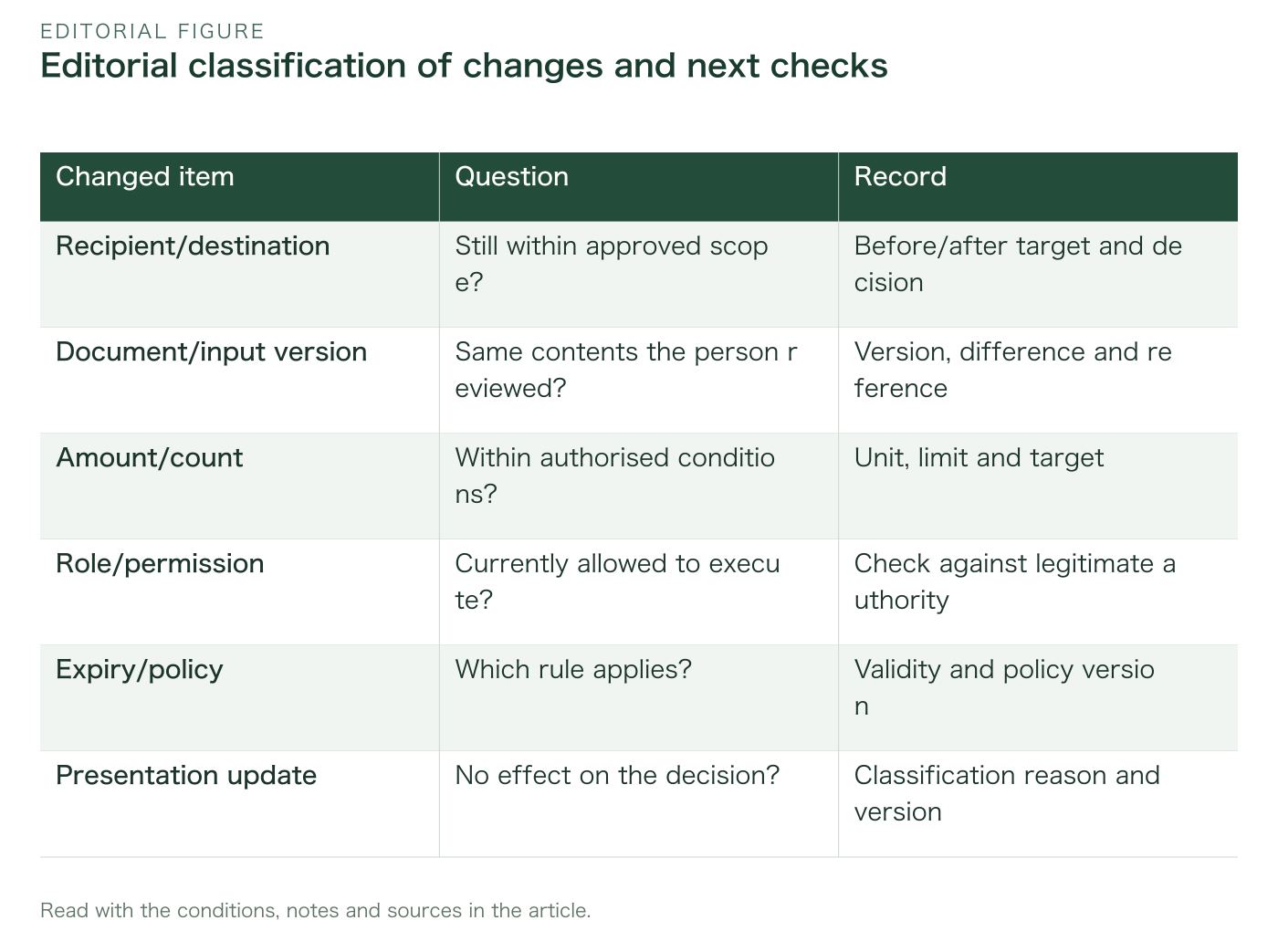
Restarting approval for every update can block work over presentation edits, while accepting every update permits changed execution. Define decision-relevant versus display-only fields, checking that supposedly cosmetic changes truly do not affect review.
Recipients, destination, amount, count and document version can change scope. Policy determines permitted variation. A range approval still needs matching units and targets. A smaller number is not universally equivalent approval.
Show semantic before-and-after differences: added recipients, changed period or a new attachment, alongside technical detail where needed. Generate summaries from the same version as execution parameters and retain access to the original review. A stale summary must not describe new contents.
Do not automatically classify an unassessable change as minor. Define stop conditions, owners and necessary evidence. Explicit scope conditions are more useful than an AI confidence number alone. Do not hide an unchecked change behind an approved flag.
Read the table as text
| Changed item | Question | Record |
|---|---|---|
| Recipient/destination | Still within approved scope? | Before/after target and decision |
| Document/input version | Same contents the person reviewed? | Version, difference and reference |
| Amount/count | Within authorised conditions? | Unit, limit and target |
| Role/permission | Currently allowed to execute? | Check against legitimate authority |
| Expiry/policy | Which rule applies? | Validity and policy version |
| Presentation update | No effect on the decision? | Classification reason and version |
EDITORIAL PRACTICE
Step 6: handle changes between checking and execution
Even a last-moment version check can be followed by another updater. If checking and writing are separate, define the intervening-change behaviour. Consider a conditional internal transition that claims execution only when expected version and state match, rather than unconditional writing after a read.
Record the execution claim separately from the external outcome. One internal claim does not establish atomicity across a provider. Check actual API support for conditional updates or duplicate identity. Unsupported boundaries may require reconciliation or manual review.
Concurrent workers must not consume one approval without limit. Use shared state for one-time actions, or include remaining count and scope for repeated actions. One process’s memory cannot reliably describe competition with another executor.
On interruption, preserve what was claimed and where outcome becomes unknown. Do not delete a stuck running record to restart. Define investigation and resumption, retaining provider references. Repairing internal state is not proof that no external action occurred.
EDITORIAL PRACTICE
Step 7: recheck at externally effective stages of long jobs
A long workflow may fetch, analyse, draft, approve and send at different times. Permission to start analysis need not authorise sending days later. Map externally effective stages and check relevant conditions before each, based on action meaning rather than waiting time alone.
Retaining a draft does not imply approval for the next send. Changed inputs may require reanalysis or an updated explanation; decide explicitly. Identical output text can still rest on changed source assumptions. Connect result and evidence versions.
At resumption, compare saved state with current authority, target and validity. Unchanged contents may proceed within scope, but do not fill gaps with old approval. Record what was checked when, not simply how often. Display progress separately from permitted action.
User states such as drafted, waiting to execute, review required and reconciling outcome clarify the next step. One processing label hides whether to wait, decide or avoid resending. Explain states through business consequences rather than expose only internal terminology.
EDITORIAL PRACTICE
Fictional case A: recipients added to an approved send
A reviews a customer document and approves one send. Another organisation is added to recipients while it waits. The body is unchanged but disclosure scope differs. A body-version-only check misses this. Link reviewed recipients to execution recipients.
Check whether the change is within scope. If not, return a clear difference for decision rather than move old approval to the new send. If an attachment also changed, show that version too. Present the whole changed target coherently.
After renewed review, verify execution matches the newly decided target. Test old browser screens and concurrent changes. Opening a correct preview once does not establish a frozen execution target. Connect both versions.
If delivery was already uncertain when the change occurred, reconcile first. New approval does not prove the original send did not happen. Additional sending before identifying which version executed obscures both disclosure scope and count. Separate approval decisions from delivery facts.
EDITORIAL PRACTICE
Fictional case B: approval remains after a role change
Suppose B’s authority for an action expires after approval because responsibility changes. The historical approval remains a fact, but execution needs a current authority basis. Deleting history and stopping present execution are different actions. Preserve history while enforcing current access.
Role handover should include waiting work by state: approved, executing, unknown and review required. Replacing only a name loses decision ownership. Retain the historical reviewer separately from the person responsible for the next check.
Do not restore old credentials merely to progress while review is incomplete. Use legitimate current authority. If its source is temporarily unavailable, record that and follow agreed waiting or escalation. An approved interface label cannot replace uncertain permissions.
For VERSAROC, map where staff records, approval history and service authority are managed. A design may include pending-job inventory and review routes where changes currently require manual pursuit. Preserve existing records and trace responsibility at each stage.
EDITORIAL PRACTICE
Fictional case C: an input changes during a long wait
C approves work based on a document, then the job waits for days while the source changes. Latest is not automatically correct: approval may concern old contents, yet executing old contents may no longer serve the purpose. Decide the version policy explicitly.
Unconditionally refetching latest can break the approved assumptions. Choose frozen execution, stop-on-change or a newly reviewed request. Show historical approval separately from current executability.
Even identical output should retain changed input identity. Similar AI text does not erase a changed premise. Where evidence must be explainable, connect sources and result. An output digest alone is insufficient approval scope.
Test changing only the source after approval and verify the expected stop or review. Also change it during processing and ensure versions do not mix. Unchanged filenames with changed contents expose name-only checks. Retain detection and the subsequent decision separately.
EDITORIAL PRACTICE
Unknown execution is not resolved by approval renewal
After a lost response, approval validity alone cannot decide resending: the external action may have completed. An internal failure label is not proof of no external effect. Reconcile using operation and provider references.
Renewed human approval also does not establish the original outcome. Its permitted scope differs from facts already occurring. For one-time actions, consider holding further effects until reconciliation, with manual escalation defined alongside implementation.
Separate approval target, execution claim, external request and confirmed result. A pre-execution validation failure differs from a communication failure after dispatch. Do not collapse them into one error state.
Show retryable and reconciliation-waiting states distinctly, including reason and owner. This can support calmer operation without promising elimination of inquiries or mistakes. Communicate uncertainty accurately so the responsible person can progress the next check.
EDITORIAL PRACTICE
Test changes after approval one at a time
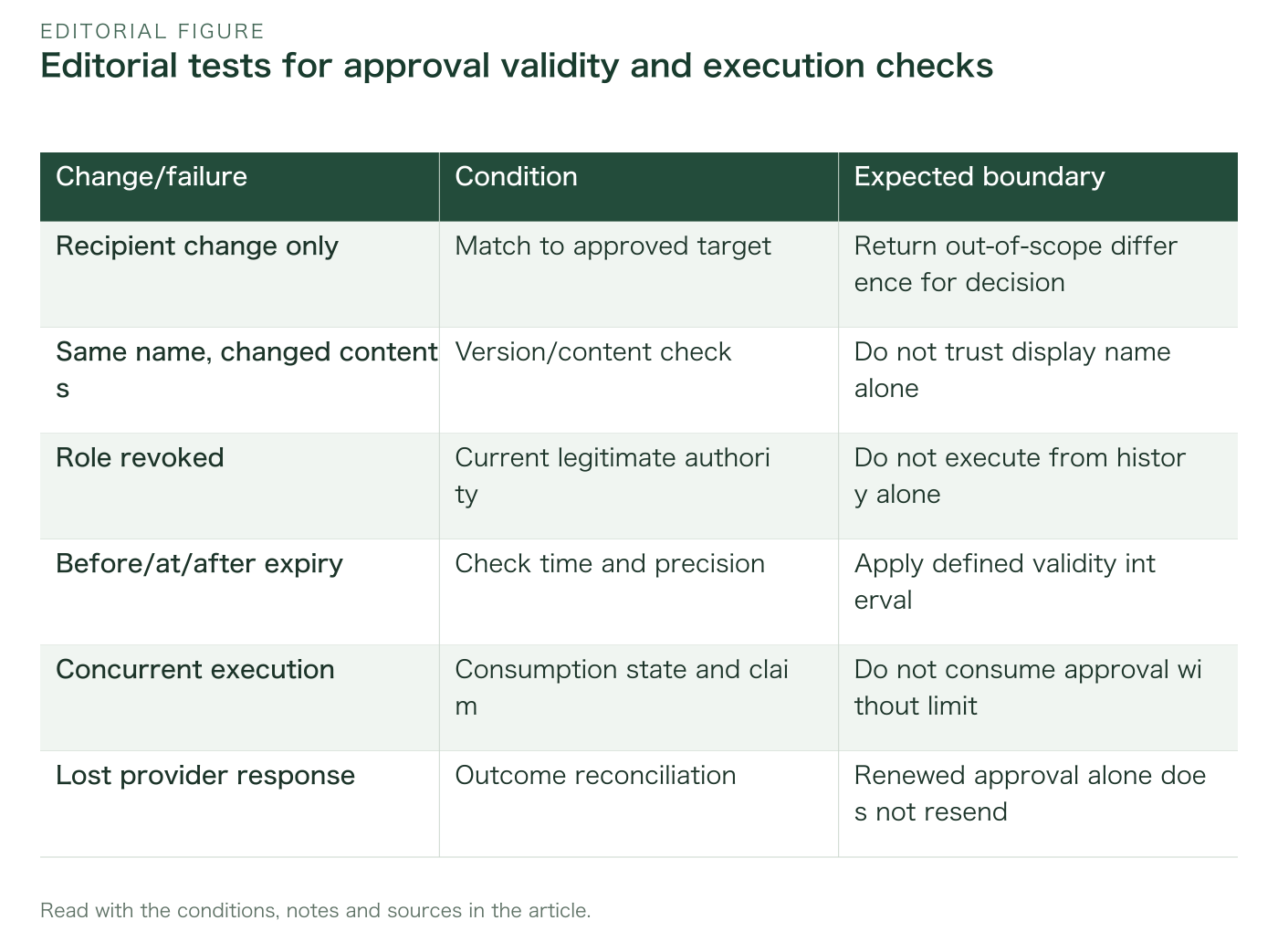
Beyond the normal path, change recipients, document version, amount, authority and time separately. Establish each decision before combining changes. Expected outcomes include proceed/stop behaviour and the explanation shown to the reviewer.
Test concurrent executors, old open screens and a crash immediately after execution claim. Internal single progression and one external effect require separate verification. Explicitly report any external boundary not verified.
Test immediately before, exactly at and after expiry. A minute-rounded screen may hide second or fractional internal precision. Check that changing the clock does not silently alter target or destination. A correct stop also needs an understandable reason and next action.
Use fictional recipients and documents. Real secrets and confidential contents are unnecessary for semantic tests. Separate those tests from authorised provider-integration checks. Report passed, pending and operationally reconciled boundaries clearly.
Read the table as text
| Change/failure | Condition | Expected boundary |
|---|---|---|
| Recipient change only | Match to approved target | Return out-of-scope difference for decision |
| Same name, changed contents | Version/content check | Do not trust display name alone |
| Role revoked | Current legitimate authority | Do not execute from history alone |
| Before/at/after expiry | Check time and precision | Apply defined validity interval |
| Concurrent execution | Consumption state and claim | Do not consume approval without limit |
| Lost provider response | Outcome reconciliation | Renewed approval alone does not resend |
EDITORIAL PRACTICE
Hand over stop reasons and the next owner
Hand over why a job stopped and what to check next, not only a state label. Expiry, changed target, unavailable permission check and unknown outcome need different resumption procedures. Contact an administrator alone hides ownership and necessary evidence.
Separate authority to change overall approval policy from authority to resume a particular job. Examine existing approvals before loosening global expiry or conditions. Record scoped exceptions explicitly; changing a global setting to pass one job can broaden impact.
For VERSAROC, map request, preview, approval, waiting, execution and reconciliation on one sheet. Identify manual gaps and missing version or permission links. Preserve history and scope staged connections. This article promises no unverified track record or complete safety.
Acceptance includes explainable stops for changed work, appropriate progression for unchanged work and reconciliation of unknown outcomes—not only finished screens. The useful result shows decisions retained by people and checks delegated to the system, rather than counts more approvals.
EDITORIAL PRACTICE
Begin by changing one approved condition in a test
Create one fictional request and preserve what the reviewer saw. Change only a recipient or document version and test whether execution detects the difference despite an approved label. Share the meaning through a small example before real operations.
Then change time or authority without changing contents. Add unknown external outcomes and concurrency last. Checking target match, present authority and execution result in sequence makes repair points clearer than implementing everything at once.
Approval is a valuable historical decision. Preserve that value by binding it to its contents rather than reusing it for different work. Current authority and historical sign-off cannot replace each other. Let unchanged scope proceed and route changed scope to the appropriate decision.
WITH OPERUN.
Delegate everyday AI management.
Delegated AI work naturally includes waiting, resumption, staff changes and updated sources. Show changed conditions while retaining unchanged parts rather than repeatedly ask identical questions. A ledger connecting target, expiry, authority and outcome makes the boundary between human judgment and delegated execution concrete.
Discuss your product and AI workPrimary sources
Sources checked on 7 November 2026. The workflows and checklists are editorial proposals.
- [1]
- [2]
Share this insight