

THE TAKEAWAYS
What to take away
- Separate syntax, column contracts, business rules and persistence
- Never guess away leading zeros, missing values, units or ambiguous dates
- Include rejection handling and contract changes in acceptance and maintenance
EDITORIAL PRACTICE
Reading a CSV is different from receiving usable business data
A CSV from a trading partner may open successfully without being safe to import into a customer or order system. A customer identifier can lose its leading zeros, an amount can mix yen with thousands of yen, or a missing quantity can become zero. A visible table and a successful process do not prove that meaning was preserved. Reducing rejections starts with agreeing what each column represents, not merely how the file is read.
RFC 4180 documents a common CSV format, including quoting, delimiters, line breaks and optional headers. It is an Informational document, not a universal specification for every CSV. It does not determine the type of a customer identifier, the unit of a quantity or the business meaning of an empty value. Keep the format reference separate from the contract your product accepts. [1]
W3C CSV on the Web metadata provides mechanisms for describing column names, titles, datatypes, required values and primary keys. It is a useful reference for expressing meaning outside the file itself. Writing metadata does not, however, prove that the chosen importer validates it. Confirm what the implementation actually checks. [2]
This article uses a fictional order import to separate format, column contracts, business rules and persistence. Its fields, limits and decisions are editorial design proposals, not a particular service specification or a complete CSVW implementation. Use them to help product owners, business operators and developers agree on acceptance criteria.
To stop repeatedly opening files and sending correction instructions to developers, define boundaries within which a team can make decisions. Agree which inputs can proceed, which return to their creator, and which require a business decision. “A CSV can be uploaded” is an insufficient definition of completion.
EDITORIAL PRACTICE
Separate syntax, column contracts, business rules and persistence
The first stage asks whether the input can be parsed as the agreed CSV format. It covers encoding, delimiters, quoting, newlines and headers. Quoted fields can contain line breaks, so splitting on line endings and then commas is not suitable for every input. Check that the selected parser and its configuration support the accepted format. [1]
The second stage checks that the required columns exist and their values have the agreed meaning. Your contract might define customer identifiers as strings, quantities as item counts, and amounts in a specified currency and unit. Matching header text does not guarantee matching meaning. Verify the contract before converting cells into database types.
The third stage asks whether the data is acceptable for the business: whether the customer exists, the product can be ordered, or the period is valid. A syntactically valid negative number might represent a return in one workflow and an error in another. That decision belongs to the business contract, not to CSV syntax or an AI guess.
The fourth stage defines the unit of persistence. Decide whether to reject the entire file or accept valid records, and how users learn what completed. Partial acceptance also needs a separate policy for resubmitting rejected records. A general retry-safety mechanism cannot establish that column meanings or corrected content are valid.
Separating stages clarifies who should act. A syntax problem may belong to the file exporter, a semantic problem to the business and integration owners, and a reference-data problem to its maintainer. Instead of one generic “CSV error,” show the boundary where processing stopped. This gives users and operators a useful starting point and reduces investigation loops.
EDITORIAL PRACTICE
Use headers to identify a contract, not merely a position
Position-only mapping can read the adjacent value when an exporter inserts a column. Name-based mapping also needs a policy for duplicate headers and renaming. Decide whether your product uses fixed positions, names or approved aliases, then keep the published instructions and the importer consistent.
W3C metadata can distinguish a canonical column name from natural-language titles. Drawing on that model, our proposal is to separate stable field identifiers from user-facing wording. This can prevent a copy change from breaking an integration while also avoiding the assumption that similar labels necessarily represent the same field. [2]
For example, a fictional contract might use customer_id, quantity and amount, with explanations for each. This is a business agreement table, not a complete CSVW metadata document. Include the relevant meaning: what is counted, whether an amount includes tax, and which date the value describes.
Treat missing required columns differently from unknown additional columns. If you ignore an extra column, make that visible so users do not assume it was processed. Extra columns may also contain unnecessary personal data. Flexible acceptance should not mean silently saving everything supplied.
If aliases are allowed, use an explicit, versioned mapping. “Trading partner code” and “customer number” may or may not mean the same thing in the source workflow. AI can suggest candidate mappings, but adoption should remain a recorded decision. Otherwise a plausible guess can become a silent semantic error.
EDITORIAL PRACTICE
Define types, units, currencies and missing values together
A customer identifier that looks numeric is not necessarily a quantity. Converting the fictional identifier 00124 into an integer removes its leading zeros. If the source distinguishes 124 from 00124, that conversion could link the wrong customer. Define which fields are identifiers and which represent quantities before importing.
For amounts, specify the unit, currency and accounting basis as well as the datatype. The number 120 has different meanings in yen and thousands of yen, although both parse as numbers. Do not infer the scale from earlier files. Decide how to return an input that cannot be matched to the agreed contract.
Blank, zero, unanswered and not applicable can have different meanings. Turning a missing quantity into zero may change an undecided order into no order. CSVW offers null and required properties, but the business must still agree which representations mean missing. Do not introduce blanket defaults solely because they are convenient. [2]
For dates, define the accepted format and meaning so a value such as 02/03/2026 is not guessed as month/day or day/month. For timestamps, also consider offsets, business cutoffs and the treatment of date-only values. A consistent format is useful, but it does not justify changing the original meaning without agreement.
Define decimals, precision and rounding per field. Converting weight, counts and prices into the same integer type can discard relevant information. If rounding is needed, agree when, at what unit and by which method. Link transformed values to their source so a changed total can be explained later.
Also consider reversibility. If leading zeros or decimals are discarded without retaining an appropriate source reference, the original meaning may be unrecoverable. Link original values, transformed values and the applied rule where necessary. This does not require retaining every raw cell forever: define the checks and retention period, then preserve the minimum evidence needed to explain a conversion.
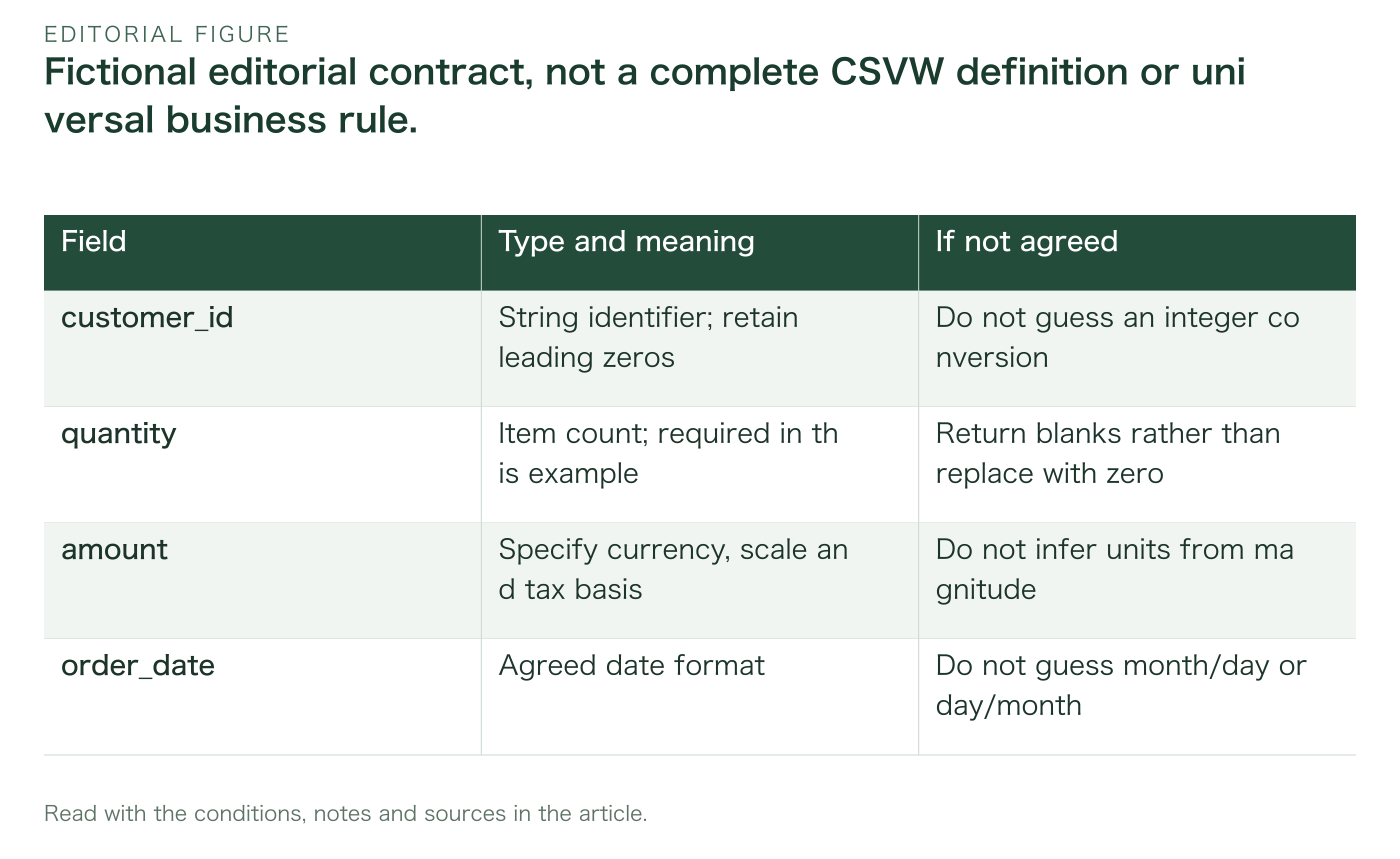
Read the table as text
| Field | Type and meaning | If not agreed |
|---|---|---|
| customer_id | String identifier; retain leading zeros | Do not guess an integer conversion |
| quantity | Item count; required in this example | Return blanks rather than replace with zero |
| amount | Specify currency, scale and tax basis | Do not infer units from magnitude |
| order_date | Agreed date format | Do not guess month/day or day/month |
EDITORIAL PRACTICE
Test syntax exceptions with actual files
RFC 4180 describes quoting fields containing commas, line breaks or double quotes, and doubling embedded quotes in quoted fields. Include these cases in small fictional acceptance files. Successful imports containing only simple letters and numbers do not test a notes field with embedded newlines and quotes. [1]
Make header presence part of the contract. Always discarding the first row could lose the first order in a headerless file; treating a header as data can cause errors or incorrect records. If you infer header presence, separate presenting that inference for confirmation from accepting the file for processing.
Choose the encodings your product accepts. Selecting UTF-8 does not mean every incoming CSV is already UTF-8. Unsupported encodings should produce useful guidance rather than silent corruption. Verify the actual decoder’s handling of any leading encoding marker as part of the acceptance check.
Embedded newlines mean physical lines and logical records may have different numbers. Explain which numbering an error report uses. A user searching in a spreadsheet and an operator reading a log may otherwise look at different locations. Include traceability back to the source file in the acceptance criteria.
Test realistic cases such as trailing empty lines, duplicate headers, inconsistent field counts and long notes. You need not accept all of them. Decide what proceeds, what returns a clear error and what awaits confirmation, then ask the development team to demonstrate that implementation and instructions agree.
EDITORIAL PRACTICE
Use four fictional records to expose unsafe conversions
Prepare four separate fictional cases: a leading-zero customer identifier, an empty quantity, an amount without an identifiable unit, and an unknown product. They require different checks rather than one generic “invalid data” response. Separating contract failures from reference-data failures makes the correction owner clearer.
Preserve 00124 as a string in the first case and use the same identifier definition when matching customers. In the second, return the missing quantity instead of substituting zero if the fictional order contract requires it. This is not a rule for every business: returns and provisional orders may need different contracts.
In the third case, a value of 120 can be understood when the accepted contract explicitly specifies yen. If another exporter might use thousands of yen without identifying that unit, do not infer it from magnitude. Source versions and business context can change the meaning of the same representation; identify the accepted contract explicitly.
The fourth record can have a well-formed product identifier that is absent from the permitted master data. Determine whether the product awaits registration or belongs to a different partner’s identifier system. Automatically creating a product is a separate business decision and permission boundary, not an implicit consequence of accepting a CSV.
Retain these records alongside successful examples so a replacement developer can verify the same outcomes and reasons. Real customer or order data is not required. Fictional records should demonstrate what is preserved, what is rejected and where human judgment resumes, and become part of the handover deliverable.
EDITORIAL PRACTICE
Return an import plan before saving production records
A preview should show more than a record count. Include the contract version, mapped columns, ignored fields, transformations and failed checks. You need not display every value, but users need enough information to decide what will happen. “Parsed successfully” should not imply that persistence is complete.
If users can adjust mappings, validate again after the adjustment. Reusing old type checks after swapping amount and quantity columns leaves a gap. Connect the selected mapping, contract version and validated input, and invalidate previous approval when the thing being approved changes.
Keep previewed content tied to the content that will be saved. A different file, changed contents under the same filename or a new exporter version must not inherit an earlier approval. A filename alone is insufficient: retain an appropriate identity for the reviewed content.
External reference data may change between preview and persistence. Decide whether to recheck a condition immediately before saving or accept data against a defined snapshot. Not every dependency can share one transaction, so business owners and developers must agree which facts are evaluated at which point.
If users face too many choices on every upload, consider a fixed contract for each source. Reduce manual approval by clarifying common formats and their change process, not by adding semantic guesses. A workflow that routes only genuine exceptions back for confirmation is easier to delegate.
EDITORIAL PRACTICE
Make rejection reports actionable at the right location
Tie an error to its record, column, rule and correction path. “Invalid type” does not tell a creator what to fix. Missing quantities, unsupported date formats and unknown products need different guidance. Also distinguish your product rules from explanations of the underlying standard.
When a record has several issues, revealing one more error after each correction creates repeated exchanges. Consider reporting multiple issues where they can be determined safely. Do not guess downstream business errors when broken syntax prevents identifying field boundaries. Report only what the parser and validators actually established.
Do not automatically reproduce all supplied data in rejection files or reports. They may contain customer or confidential information. Consider limiting output to what is needed for correction and identification, with appropriate access, storage and retention. A diagnostic export should not become an unmanaged new original.
If partial acceptance is supported, clearly distinguish accepted records from returned records and explain what happens if the original whole file is submitted again. Technical duplicate prevention is separate from checking whether a corrected record is valid new business content. Neither alone guarantees safe reacceptance.
When discussing an importer with VERSAROC, describe which field meanings people repeatedly check, not just how many rejections occur. Source-specific contracts, preview, correction reports and operational handover can define the work delegated to a development team. The aim is to route necessary human decisions correctly, not to promise automatic business correctness.
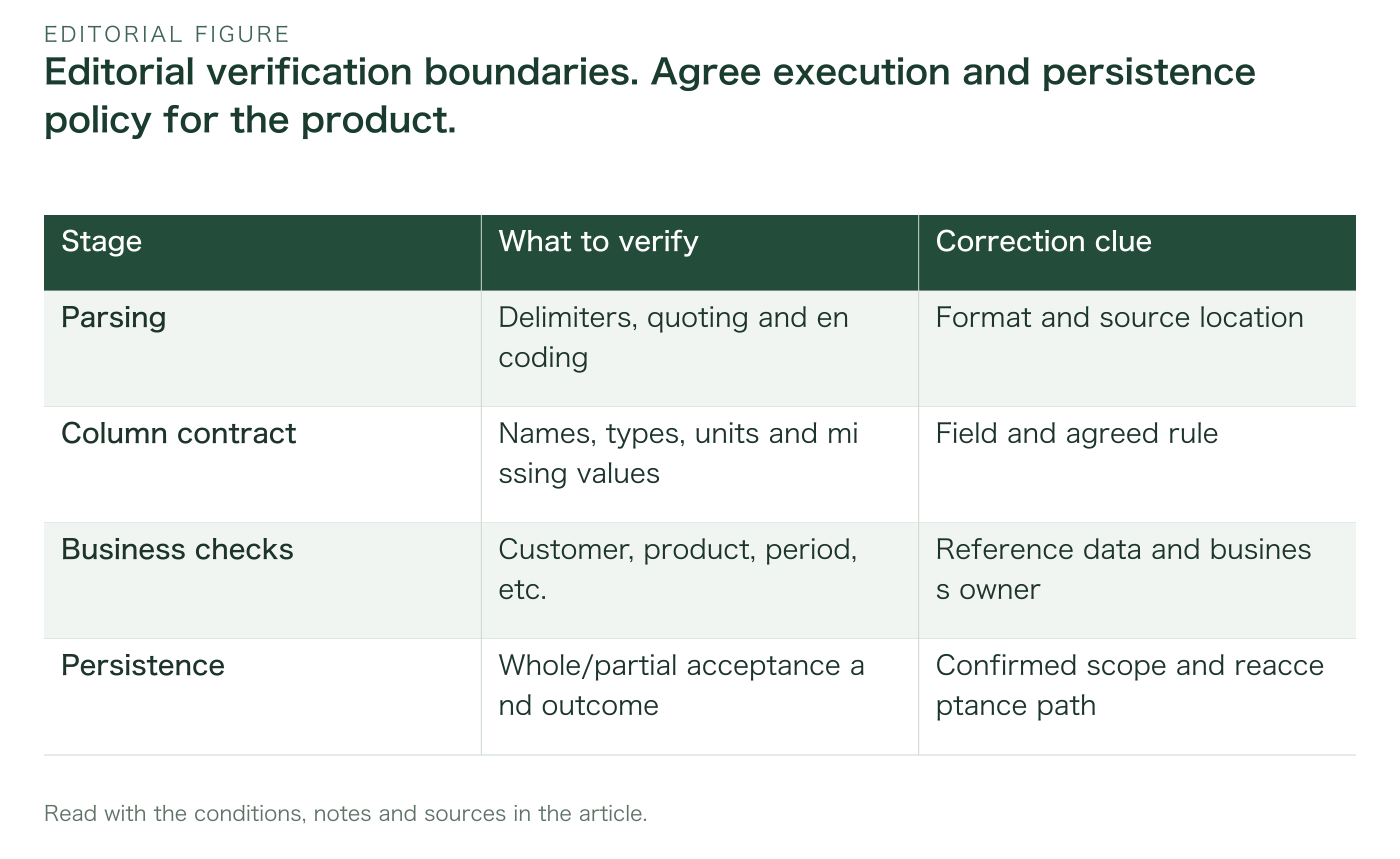
Read the table as text
| Stage | What to verify | Correction clue |
|---|---|---|
| Parsing | Delimiters, quoting and encoding | Format and source location |
| Column contract | Names, types, units and missing values | Field and agreed rule |
| Business checks | Customer, product, period, etc. | Reference data and business owner |
| Persistence | Whole/partial acceptance and outcome | Confirmed scope and reacceptance path |
EDITORIAL PRACTICE
Decide between whole-file and partial acceptance before persistence
Saving only part of a file can break totals or relationships when the business requires file-level consistency. For many independent records, processing the valid portion may be appropriate. Neither is universally correct. Agree the policy from the business unit and the explanation users need, rather than letting an intermediate failure choose it implicitly.
For whole-file rejection, define a boundary that prevents persistence starting during validation. For partial acceptance, specify the unit, completed scope, failure states and reacceptance process. If other systems are notified, distinguish saving data from completing notifications. Simply telling users to retry everything after a failure may duplicate work.
Explicitly decide how to handle two records with the same business key instead of silently keeping the later one. Duplicates within one file and matches against existing records are different cases. State whether the import adds, updates or replaces data, and do not skip content validation merely because the key already exists.
Distinguish states such as validated, waiting to save, saved and outcome unknown. These labels are editorial examples, not platform guarantees. Base actual states on observable facts and ensure the user interface and operational record refer to the same outcome.
Acceptance checks should cover changing conditions before persistence, interrupted connections and partial failures as well as success. They need not run against production data. Use a small isolated environment and fictional records to demonstrate what is certain and what needs reconciliation, then include that evidence in the delivery.
EDITORIAL PRACTICE
Version column contracts together with incoming formats
Exporters may add columns or change their meaning. Beyond accepting unknown columns, distinguish required additions, type changes, unit changes and renaming. Do not apply a new contract to every old file automatically. Define which input versions are accepted and for how long.
Choose a version-identification method suitable for the product, such as an import configuration, explicit version or source identifier. Do not infer semantic changes solely from a date in the filename. Unidentifiable formats should return for confirmation rather than selecting a version because the numbers happen to parse.
If versions coexist during migration, specify what can be transformed. Splitting one old column into two meanings may require information that does not exist. Record transformation rules, information loss and inputs needing confirmation so the migration team does not invent missing values.
Provide exporters with the changes, effective date, accepted versions and fictional test samples. Updating the receiving system alone does not update incoming files. Separate sending the change notice from verifying receipt of a new-format file, and track which partners or departments have actually migrated.
When retiring a version, consider pending files and reprocessing. Applying a new contract to an old input may produce a different result. Linking the input contract, validation result and persisted content helps explain the decision that was made at the time.
EDITORIAL PRACTICE
Accept the exception-handling operation, not just the interface
The deliverable should include more than a screen that imports a valid file. Require the column contract, fictional success and failure examples, rejection guidance, persistence boundaries and a change process. Agree which problems the team maintains and which meanings remain business decisions so every question does not return to the product owner.
Acceptance material should connect executable rules with human instructions. Check mismatches such as a supposedly required field accepting blanks, or a string preview becoming an integer during saving. Ask the team to verify that parsing, validation, persistence and error reports follow the same rules, rather than merely editing the explanatory copy.
Monitor error categories and correction owners as well as counts. One source changing column meanings or one department retaining an old version may call for a contract or communication improvement rather than repeated manual repairs. Retain only necessary diagnostic information; routinely pasting entire source files into logs is not an appropriate default.
AI can assist with mapping suggestions and explanatory text, but supplied content must not become an instruction to change business rules or permissions. Accepting unknown columns, creating customers or overwriting existing data should remain explicitly authorized operations governed by the agreed contract.
For a VERSAROC consultation, identify current files, repeatedly corrected columns, confusing messages and the maintenance work you want to delegate. Fictional representative examples and expected results can precede sharing real data. Consider a team-owned workflow covering validation, rejection and contract changes alongside the import function itself.
EDITORIAL PRACTICE
Turn repeated column repairs into an agreement and verification process
Reducing CSV rejections requires separate checks for parsable syntax, matching column meaning and business acceptability. Agreeing identifiers, units, currencies, missing values and dates narrows the decisions that must be made manually on every file. The objective is not to eliminate exceptions but to route them to the right decision maker.
Start with representative successes and semantically distinct failures. Connect sources, mappings, transformations, persistence units and rejection guidance in one acceptance package. Instead of automating everything immediately, stabilize agreed formats and clearly stop inputs outside those boundaries.
When specifications change, update both human instructions and machine-readable contracts, including treatment of old versions. Traceable historical versions help investigate different results from the same file. Make ongoing review of rejections and improvements to contracts and guidance part of the team’s operational deliverable.
The primary references were checked on November 7, 2026: RFC 4180 and W3C tabular metadata. Do not impose the RFC as a universal rule for every CSV or assume that adopting CSVW metadata means validation occurs. The business rules and interface examples in this article are editorial proposals that require confirmation in the selected product and implementation.
WITH OPERUN.
Delegate everyday AI management.
If CSV corrections and transcription are delaying product improvements or new work, separate the decisions you retain from the checks and maintenance you can delegate. Use OPERUN’s contact route to describe what you want to build and continue handing over. The goal is a workflow that delivers meaningful data to the business, not one that makes ambiguous columns look convenient.
Discuss your product and AI workPrimary sources
Sources checked on 7 November 2026. The workflows and checklists are editorial proposals.
- [1]
- [2]
Share this insight