

THE TAKEAWAYS
What to take away
- Bind customer identity to authorised use and retain unallocated cost explicitly.
- Keep estimate, reservation, measurement and invoice states distinct, with pricing and aggregation versions.
- Preserve source shared costs and allocation rules without double-counting totals.
- Check both customer and global limits; billing alerts are not immediate admission stops.
- Reflect the difference between customer charges and internal cost in reports and access rights.
EDITORIAL PRACTICE
A provider invoice and customer cost answer different questions
When an AI invoice rises, can you identify which customer’s work changed? A total does not reveal customer cost, shared infrastructure or unallocated amounts. Looking only at customer charges can hide retries and common processing behind them.
Here, tenant means the business unit to which cost is assigned. Define whether that is an organisation, contract or project using actual contracts and permissions. Combining or separating departments is also a policy decision. A customer name supplied by a user is not sufficient attribution authority.
This article connects explainable customer cost with admission limits, rather than merely copying an existing batch cap per customer. Separate direct, shared and unallocated costs and trace estimates through invoice reconciliation. Figures and allocation rules are fictional editorial proposals, not actual prices or accounting standards.
First identify the audience and purpose. Debugging detail, management cost reports and customer invoices need not be identical views. Share underlying usage facts while distinguishing rules, finalisation and access. Centralising numbers does not automatically unify their meaning.
EDITORIAL PRACTICE
Check the scope and delay of provider attribution
AWS documents that tags may take up to 24 hours to appear in Billing and advises against sensitive information in tags [1]. Tagging capability does not establish immediate, complete customer attribution. Check delay and covered costs.
Current Bedrock documentation describes model-specific application inference profiles and distinguishes supported InvokeModel/Converse use from Responses/Chat Completions, which do not support AIPs [2]. Even within one provider, API conditions differ. Verify the method actually used.
AWS Budgets also documents delay between cost occurrence and notification, including possible threshold exceedance before notification [3]. Retrospective monitoring is not an immediate admission stop for every request. Identify the information time behind each decision.
Design the internal ledger around those limits. Decide whether a figure reproduces provider charges, allocates business cost or estimates spending for admission. Choosing a feature first and expanding its purpose later encourages different meanings to share one cost field.
EDITORIAL PRACTICE
Step 1: bind customer identity to authorised use
At entry, verify which tenant an authenticated user may act for and pass the confirmed identity into processing. Do not derive attribution from a display name or arbitrary request field. Test that supplying another tenant identifier cannot move cost or records there.
A stable internal identity can survive customer renaming. Separate name, invoice recipient and internal identifier so historical usage remains traceable. For mergers or contract splits, retain when attribution changes.
Send only necessary metadata to providers. Cost tags need not contain names, email addresses or prompts. An opaque internal identifier with a controlled mapping can support attribution. Traceability does not require broadcasting personal information.
Preserve tenant and operation identity through queues, AI calls, storage and retries. If identity is lost, do not assign the usage to the most recent convenient customer. Explicitly unallocated cost is easier to correct than a falsely final attribution.
EDITORIAL PRACTICE
Step 2: distinguish estimate, reservation, measurement and invoice
An estimate describes possible future cost; a reservation holds admission capacity; a measurement reflects observed usage or calculated cost; an invoice records provider billing. Adding all four as final cost counts one job repeatedly.
Keep the usage identity and state transitions. Preserve estimate history without counting it again after measurement replaces it. Releasing a reservation does not make incurred cost zero. Admission capacity and cost reporting have different roles.
Measured entries need quantity, unit, pricing version, currency and calculation time. Input, output and cache categories must follow the actual provider. Do not assume common units or discounts across services. Label estimates and do not treat an unverified rate as current.
Customer charges may follow a separate contract calculation. Flat, usage-based or minimum charges belong to the actual agreement, not this article’s recommendation. Avoid a hidden rule that updating internal cost automatically changes the customer invoice by the same amount. State the relationship explicitly.
Observed usage with an unverified rate is not final cost. Record which component is measured and which remains estimated. Carry provisional labels into saved exports too, rather than mark only the screen while downloaded tables appear final.
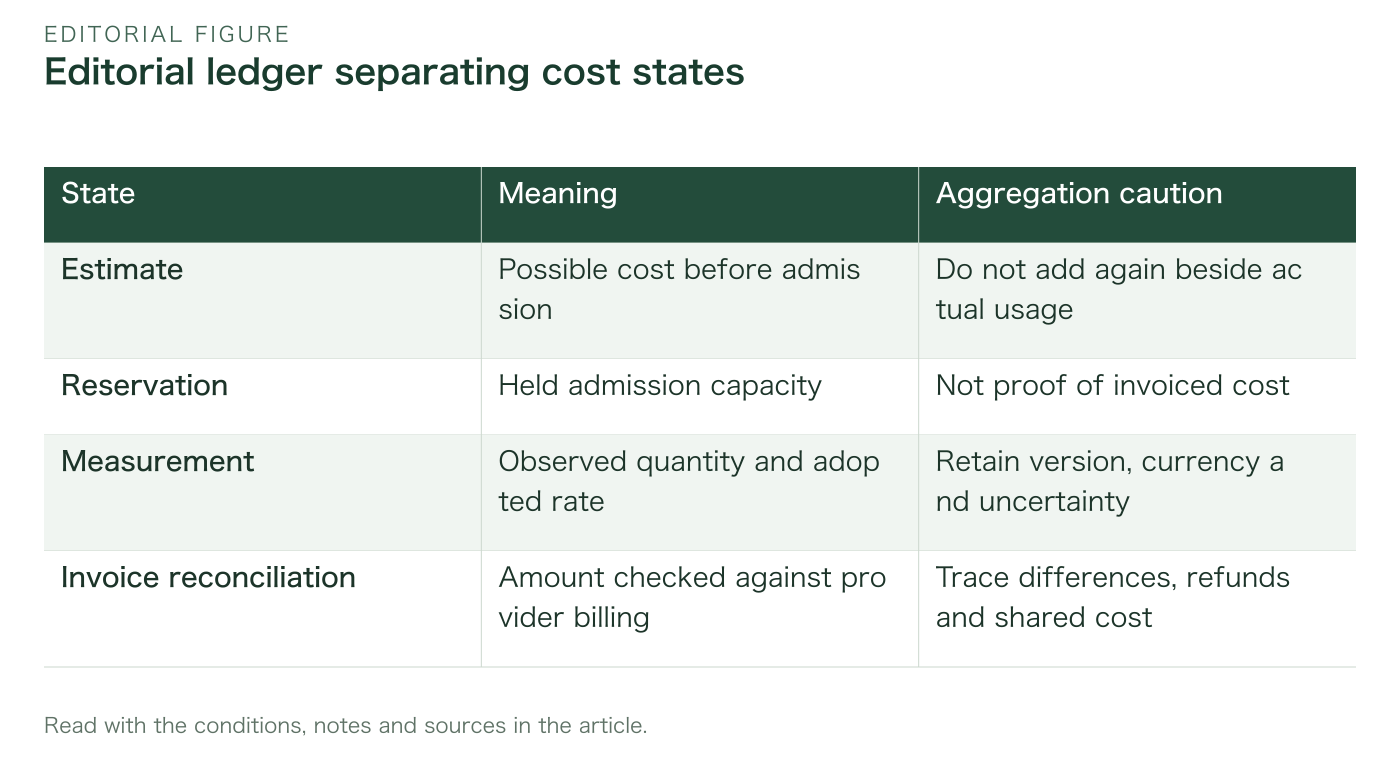
Read the table as text
| State | Meaning | Aggregation caution |
|---|---|---|
| Estimate | Possible cost before admission | Do not add again beside actual usage |
| Reservation | Held admission capacity | Not proof of invoiced cost |
| Measurement | Observed quantity and adopted rate | Retain version, currency and uncertainty |
| Invoice reconciliation | Amount checked against provider billing | Trace differences, refunds and shared cost |
EDITORIAL PRACTICE
Step 3: separate direct, shared and unallocated cost
Define direct cost as supported attribution to one tenant; shared cost as spanning use and needing an allocation policy; unallocated cost as not yet attributable. This explains gaps between customer totals and provider totals instead of hiding them as error.
A fictional ¥10,000 comprises ¥4,000 direct to A, ¥2,000 direct to B, ¥3,000 shared and ¥1,000 unallocated. The ¥6,000 direct total does not make the other ¥4,000 disappear. Name totals according to whether allocation has occurred. Direct-only cost is not total cost.
Automatically moving unknown amounts into shared cost can balance a display while concealing lost identity. Distinguish legitimate common infrastructure from missing information. Retain source records and correction history for later attribution. Unknown ownership does not mean no cost occurred.
For a VERSAROC implementation discussion, map where costs are identifiable and where attribution breaks. Scope more than a customer dashboard: trace queue, AI provider, storage and invoice report links. Include explainability from source usage records in acceptance.
EDITORIAL PRACTICE
Step 4: version the shared-cost allocation policy
Possible allocation bases include usage, processing count and contractual responsibility. Technology alone cannot decide universal fairness. Agree the report’s purpose, cost scope and basis with the business owner. Allocation for internal cost need not equal customer charging.
Allocating the fictional ¥3,000 two-to-one gives A ¥2,000 and B ¥1,000. Combined with direct costs, A has ¥6,000, B ¥3,000 and ¥1,000 remains unallocated: still ¥10,000. Adding the original shared ¥3,000 again double-counts it. Preserve the source-to-allocation relationship and label the view.
Specify the ratio’s period and population. Daily ratios versus monthly use can change outcomes. Decide treatment of stopped or new customers and sparse periods. Do not select convenient ratios retrospectively; date and explain policy changes.
Check actual measurement for shared cache and preprocessing. Reuse does not universally mean zero cost or require charging everything to the first customer. Separate measured cost from allocation judgment. Mark unmeasurable scope instead of inventing precise certainty.
Include rounding in allocation policy. Rounded customer amounts can leave a remainder against source shared cost. Define assignment or a separate adjustment consistently. Do not silently push the balancing difference to one customer; preserve both total and rationale.
EDITORIAL PRACTICE
Step 5: enforce both tenant and global capacity
Tenant limits alone do not protect the total. With fictional capacities of 80 for A, 70 for B and 100 globally, individually permitted requests can total 150. These are explanatory units, not prices. Check tenant and service-wide conditions in admission.
Parallel jobs that independently read remaining capacity may all see the same headroom. Consider reserving capacity before admission and proceeding only after reservation succeeds. The separate budget article covers implementation detail; here the key is tenant attribution linked to global reservations.
Retrospective cost reports and admission estimates have different update times. Work absent from billing can still occupy reserved capacity. Display confirmed spending separately from possible future commitments. No billing alert is not permission to admit immediately.
Agree hold behaviour, priority, user messaging and administrator override scope with the business. Raising an operational cap is not approval to charge a customer. Separate technical admission from contractual charging decisions.
EDITORIAL PRACTICE
Step 6: do not close an unknown call as zero cost
A request sent to an AI provider without a received response may still have executed. Do not translate timeout or disconnection into zero usage. Preserve call identity, attempts and provider references and reconcile an unknown state. A retry remains another attempt of the same request.
One customer result can involve several charged attempts. Check actual measurement rather than count only the successful final attempt. Retry cost and reasons help distinguish operational improvement opportunities from ordinary demand growth.
Reservation release also needs more than success/failure. Immediate release for unknown calls can admit more while cost is still occurring; permanent reservation prevents use. Agree reconciliation deadlines, sources and release or correction authority.
When usage becomes known later, retain the earlier uncertainty and record reconciliation date, evidence and adjustment. Customer-facing detail can vary, but internal history must explain changed figures. Unknown is a necessary cost-ledger state.
EDITORIAL PRACTICE
Step 7: reconcile equivalent invoice scopes
Before comparing ledger and provider invoice, align period, currency, tax, refunds, discounts and service scope. A pre-tax estimate differing from total payable is not automatically missing usage. Write the comparison scope and separate explanatory differences. Retain conversion basis and version where currencies change.
Label customer cost provisional before invoice finalisation. Later adjustments need the original cost period and correction period. Do not attribute a late charge to whichever customer is current now. Separate usage timing from processing the correction.
Reconciliation need not force every provider aggregate into individual lines. Define what the available granularity can verify. Explain finer tenant attribution from internal records and distinguish externally matched values from policy allocations. Do not erase differences to simulate exact agreement.
Matching totals can conceal over-attribution to A and under-attribution to B. Test overall reconciliation and tenant ownership separately. Trace usage identity through cost, allocation and display; correct addition alone does not complete customer explainability.
Invoice imports need source, period and version too. Test duplicate imports separately from accepting a corrected report. Duplicate protection should not block legitimate adjustments; distinguish retransmission of the same file from a new version.
EDITORIAL PRACTICE
Fictional case A: untagged usage displayed as zero
Suppose A’s usage is absent from the billing screen and an operator displays zero cost, despite completed jobs in the internal ledger. Provider delay and lost identity remain unresolved. A final zero makes no usage indistinguishable from unknown usage.
Check internal execution and external cost separately. Known work can remain provisional with an estimate or count. Consider documented tag delay [1], but do not assume delay and skip identity investigation. Record the verified scope.
When attribution becomes known, retain its basis and date and explain the change from provisional display. Correct any earlier zero impression. Newly occurring work differs from assigning ownership to existing work; make the display reason specific.
Acceptance must cover more than the final total. Check that unknown is not called zero, resolved amounts are not counted twice and correction history remains. Use pre-reflection, reflected and unidentifiable examples to expose the branches.
EDITORIAL PRACTICE
Fictional case B: allocation changes the apparent customer ranking
A service can show a different customer ranking after shared costs are allocated. Frequent shared preprocessing and heavy individual processing respond differently to the chosen basis. A changed ranking is not automatically new demand. Separate policy changes from usage changes.
Compare old and new policies against the same period. Retain rationale, approval owner and effective date. Preserve compared versions rather than silently replace all history. Any customer-contract impact requires a separate decision.
Minimum common responsibility for small customers is also a business question. Align pricing design with the purpose of internal cost analysis. Calculability does not establish fairness. Implement reproducible policy records while the decision owner remains able to explain the choice.
A report separating direct cost, allocation and unknown amounts makes changes explainable. Do not leave users guessing behind one cost total. Not everyone needs all detail, but authorised staff need a route back to calculations and policy.
EDITORIAL PRACTICE
Fictional case C: a model change overwrites historical pricing
Suppose a model or API change updates only the current pricing table. A screen multiplying historical usage by that current rate makes an old run’s cost appear to change. A new-rate scenario and a historical cost record answer different questions.
Retain model/API identity and the adopted pricing version. Operationally manage verified sources and effective dates rather than fix changing prices in this article. Explain differences between provider billing and internal calculation. Separate permission to edit rates from permission to correct final history.
Compare model changes using comparable tasks and usage examples. Lower unit cost does not guarantee the same percentage reduction in operating cost if quality or retries change. This article guarantees no model ranking or saving rate. Distinguish measured results from forecasts.
Historical repricing can be useful as a labelled scenario with its own version. Do not replace invoice-reconciled actuals. Name shared results as actual, recalculated or projected. Correct arithmetic under a misleading label still leads to poor decisions.
EDITORIAL PRACTICE
Separate customer reports from internal investigation access
Customer screens need not expose every internal record. Contractual charges and allowance explanations differ from investigative detail. Define customer and staff access. Check that an API does not return other customers’ data merely hidden by the interface.
Tenant filtering must follow authorised scope, not be only a freely selected search parameter. Apply the same boundary to exports and downloads. A correct list with cross-tenant detail or CSV leakage does not protect the ledger.
Consider separate permissions for seeing totals and correcting attribution. Investigation access does not imply authority to rewrite old allocations. Corrections need reason, before/after values and appropriate approval. Use references to source records rather than broad copies of sensitive content in logs.
Shared reports should include period, policy version, finalisation state and access scope. Prevent an old export being mistaken for current information and retain relationships between regenerated documents. Explainable cost includes who sees which assumptions, not arithmetic alone.
For shared links, check current access at the destination. Past access to a report does not authorise current access to another tenant’s details. Recheck scope after corrections or staff changes. Cost history and access history are related but distinct decisions.
EDITORIAL PRACTICE
Test conservation of totals and correct attribution separately
Begin acceptance with small fictional direct, shared and unallocated entries. Confirm the total survives allocation without counting source shared cost twice. The ¥10,000 example verifies A ¥6,000, B ¥3,000 and ¥1,000 unknown together with the basis, not only the overall sum.
Add later attribution, invoice correction, repeat delivery and an unknown call resolved later. Test changing numbers as well as one normal measurement. Preserve history without introducing the same cost as a new item.
For global admission, test simultaneous requests individually permitted but collectively exceeding capacity. Also check that one exhausted tenant does not unnecessarily block others. Expected outcomes include decision point and user response.
Include display and access: provisional remains provisional, cross-tenant detail is denied and rate changes do not silently rewrite history. Use fictional data for semantics, with any necessary production reconciliation conducted separately within authorised scope.
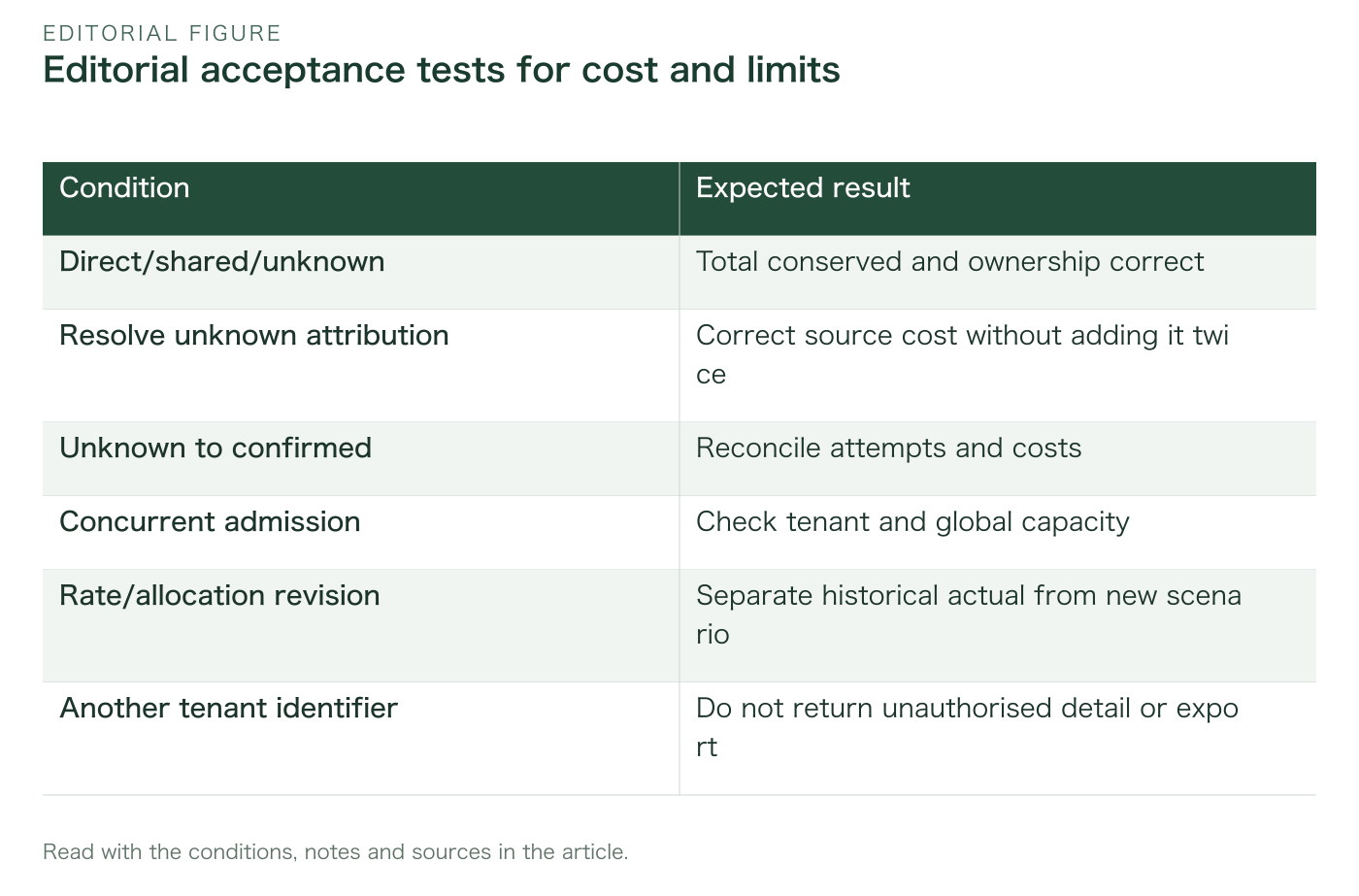
Read the table as text
| Condition | Expected result |
|---|---|
| Direct/shared/unknown | Total conserved and ownership correct |
| Resolve unknown attribution | Correct source cost without adding it twice |
| Unknown to confirmed | Reconcile attempts and costs |
| Concurrent admission | Check tenant and global capacity |
| Rate/allocation revision | Separate historical actual from new scenario |
| Another tenant identifier | Do not return unauthorised detail or export |
EDITORIAL PRACTICE
Hand over reconciliation responsibility, not only an update button
Handover includes usage identity, state meanings, allocation policy, invoice-check timing and correction procedure. Name who investigates unknown attribution, changes rates or policy and finalises differences. An update button alone does not create explainable operation.
Set follow-up timing and owners for unknown costs. Do not guarantee same-day resolution; show uncertainty and the next check. Older unresolved items must not disappear beneath new summaries. Provide a route back to them, not only balanced months.
For a VERSAROC discussion, identify broken links among spreadsheets, provider reports and execution logs. Define cost meaning before building dashboards, admission control and reconciliation at once. Use staged implementation and acceptance while preserving existing records.
Success includes traceable differences, corrections and admission decisions, not only attractive charts. Promise no unverified savings or margin improvement. First explain whose cost is shown under which policy and time. That makes operational improvement candidates easier to identify.
EDITORIAL PRACTICE
Start by tracing one use through to billing
Start with one customer request rather than precise allocation rates for everything. Trace admission, provider call, usage, calculation, allocation and invoice reconciliation. Lost identity or changed information time identifies implementation priorities. Do not conceal gaps with averages.
Then add shared and unallocated cost and check total conservation. Matching customer totals still requires separate ownership checks. Separate admission limits from delayed provider alerts. Aim to trace cost explanations and spending control through connected records.
Use provider attribution with its scope and delay understood. Not every API accepts the same tags and not every charge is immediately final. Preserve verified provider facts separately from company allocation and display policy. That boundary helps future change reviews.
WITH OPERUN.
Delegate everyday AI management.
Customer AI cost is an operating process connecting direct usage, shared cost, uncertainty, correction and contractual charges. Preserve facts, version calculations, expose unknowns and explain them to the right audience. That moves cost management from individual intuition into reviewable team operation.
Discuss your product and AI workPrimary sources
Sources checked on 7 November 2026. The workflows and checklists are editorial proposals.
- [1]
- [2]
- [3]
Share this insight